 Tyson Heckert
League of Dungeoneers is a self-described RPG dungeon crawl and party management board game, though I would argue it’s really more of a GM-less TTRPG with board game elements. It’s a hard one to put a finger on, since it does a lot, but plays very familiar. For my money, it’s closer to solo D&D than, say, Warhammer Quest, but the comparisons to both are apt. Different from a solo RPG, there are similarities to that style of game as well.
From publisher von Braus publishing
League of Dungeoneers (LoD) is a detailed Dungeon Crawl and party management game. The game is designed to be a solo/coop game but could be played with a game master as well. The main task of the game is to develop your characters both by gaining experience but also by finding gold, equipment, magic and legendary items that can help you in your quest. The game is set in its own fantasy universe, containing many of the races and monsters that you would expect from a classical fantasy setting. You could either run the campaign supplied with the game or run any of the 22 single quests.
[ . . . ]
This game does not focus on stream lining, but rather on creating a detailed dungeon crawler experience. It will require more on the behalf of the player than some of the more modern designs, but for me it’s the perfect level of detail.
Overview
Originally created as a print-and-play, I believe, League of Dungeoneers has a long history. It eventually reached a point where physical components were possible, crowdfunding on Kickstarter, then on Gamefound for the first print and expansion, and then a separate campaign for acrylic standees and the Advanced Bestiary. Thankfully, the game is not rare or exclusive. Readily available on the publisher’s website, limited copies are supplied for the time being.
Player count
Supporting 1 – 4 players, soloists are encouraged to use a full party of four heroes. Mercenaries can fill in the gaps for parties with less, but they are not nearly as powerful. My preferred solo party, then, is three complementary heroes, plus a rotating mercenary.
While the game is GM-less, meaning quests, dungeon layouts, enemy AI, and loot are all procedurally generated, I actually think that a GM, or at least a facilitator, could easily pop into the mix. It might actually be preferable when playing with a gaming group that want to move a little faster and have someone referee.
Play time
Dungeon crawling in League of Dungeoneers can take around two to four hours. This varies with dungeon size, luck in finding the objective room, and how many encounter combats and how tough they are. But crawling isn’t all there is to it. From city actions to narrative events on the road, a lot more can happen. Players can easily spend an hour or two in towns or travelling between, especially if an event occurs and starts a combat skirmish. Pre-defined campaigns run in ten quests or less, but there are several of them, and they can be stopped or started at any time. Then the potential for side quests pops up whenever the players check for them in town.
Gameplay
League of Dungeoneers is heavy and crunchier than double-fried fish and chips. Play feels much like a combination of Warhammer Quest and D&D. The dungeon crawling is about on par with WHQ, but the moment-to-moment gameplay is closer to D&D. There’s initiative, wandering monsters, party morale, resting, searching, traps, tile hazards or events, and a massive amount of complexity to combat, spells, and even alchemy.
While most of a player’s time will be spent in its randomly generated dungeons, there’s plenty to do and see outside them as well. With far too many systems to mention here, I’ll just say that for anyone familiar with old school RPGs, the game captures that spirit perfectly while never losing focus on the dungeon crawling.
Character Creation
Any good RPG is going to start with character creation. While your average board game is going to provide a choice of pre-made characters, here, players make their own. It’s extremely D&D-like, with similar choices of race, class, stat proficiencies, perks, talents, background, and equipment. It’ll take 30 minutes to create a single character. Sticking with classic fantasy tropes, the choices feel familiar to anyone who’s played old school RPGs. This mostly revolves around humans, elves, dwarves, and halflings, then fighters, wizards, thieves, and war priests (clerics). The standout is probably the Alchemist class, but more on that later.
Adding one additional layer of spice, characters can optionally start with a background. This often adds another objective, just for them, and another reason to travel or dungeon crawl in specific ways.
There’s no big plastic board to keep track of a character in League of Dungeoneers. Players get a sheet of paper to fill out, and will need to update it as they go. I suggest laminating a copy and using dry erase for the most important stats, but getting away with pencil and eraser also works just fine, and it’s my personal preference.
Overland & Quests
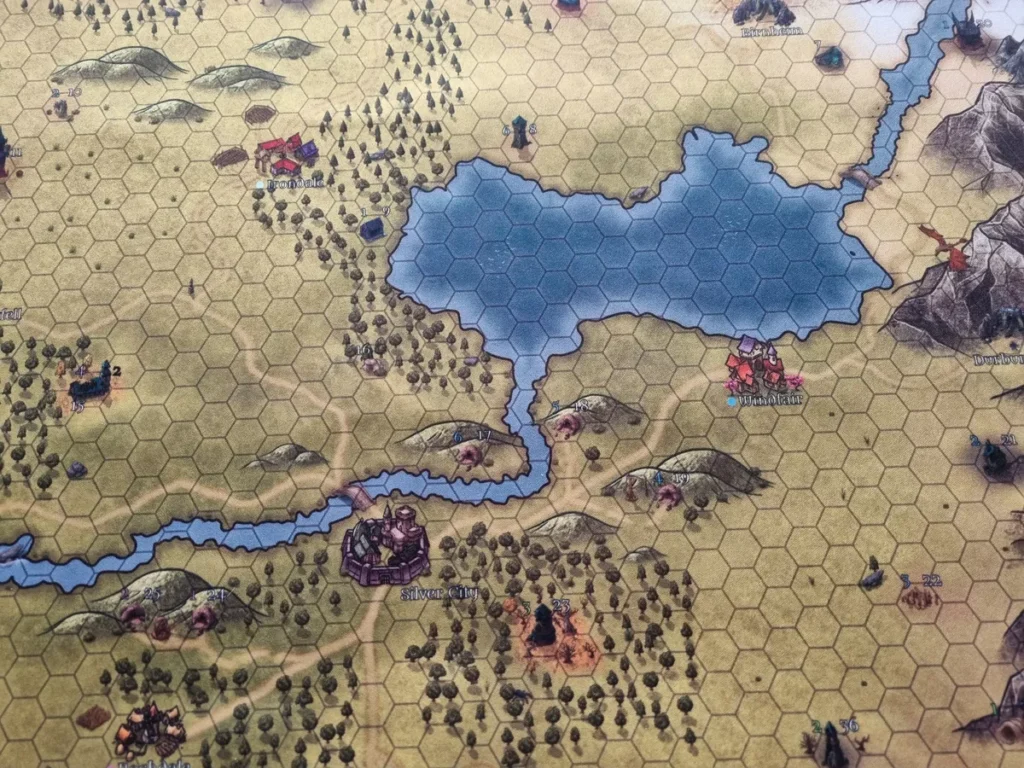
Several campaigns are included among the core rules’ Quest Book I, separate Quest Books II, III and an additional, smaller campaign in the Ancient Lands. That’s already a lot to do. In addition, each settlement, or more in the Silver City, always has the opportunity for random quests based around one of several objective rooms. These are very much like Warhammer Quest in that regard. In true sandbox fashion, however, players are free to start and stop any quest or campaign as they like. Those in the Ancient Lands are meant for higher level characters who have completed the first campaign, however. Some campaigns are self-contained, deadly dungeons, while others are more sweeping and take place across the continent. Mixing and matching is encouraged as the sandbox is wide open!
Dungeon Crawling
As the star of the show, League of Dungeoneers creates its terrifying tombs randomly. Taking a cue from the old Warhammer Quest system, room and corridor cards, according to the quest description, are shuffled together then split into equal piles each time the party reaches a fork in the dungeon. Separated by doors that are trapped and/or locked, players venture through these areas in search of the objective room, where they follow quest specific instructions to win.
All tiles have the chance for an enemy encounter. This is determined by a d100 roll, then enemies are chosen by rolling on another table that’s scaled to the highest character’s level, ensuring combat difficulty is about right.
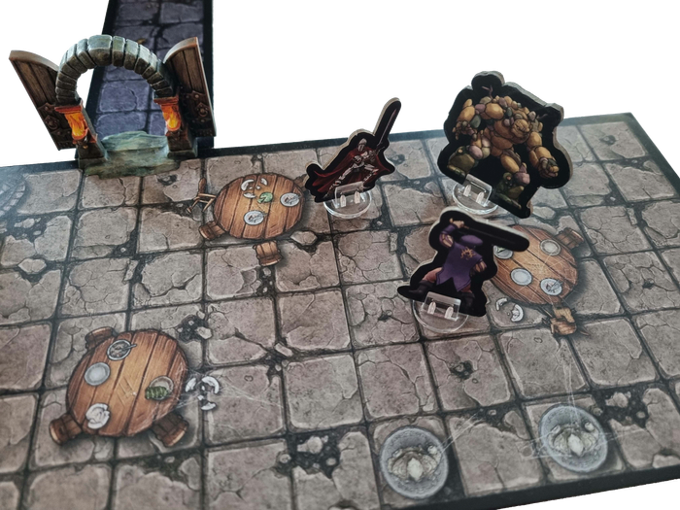
In addition, almost all areas will have something unique, like something to search, a trap, or a point of interest to interact with. What’s especially cool is that the tile art corresponds to these. Is that a treasure pile behind that monster? Sure is, and the card describes it as searchable. Followed your nose to a monster mess hall? Yeah, and all the tables can be searched. While this will probably result in finding foodstuffs or knick-knacks, there is always the possibility that someone left their legendary item behind a barrel somewhere. That would be a massively, exceptionally rare find, requiring a very good dice result, then two subsequent very rare card pulls. But hey, you never know.
Finally, there’s Threat. This measures the darkness that’s gathered in the dungeon, and if the die fall unfavorably, will result in something happening. Generally, this is wandering monsters, but it could be a few detrimental effects. There’s even a mechanic where players can close doors behind them and wedge them shut, slowing wandering monsters considerably.
Crunch
There are a lot of rules in League of Dungeoneers. This is why I consider it closer to a TTRPG, even though the main focus stays on the dungeons and their board game style crawl. There are rolls to hit, modified by actions (like aiming or power attacking), Talents, Perks, enemy stats, and positioning – from attacking from behind, prone, elevated positions, and more.
Enemies hit a certain part of a player’s body, which can have armor, or even overlapping armor. Players can dodge, parry, or both depending on stance, equipment, and talents. Spells need a die roll to properly cast, and can miscast, require mana, line of sight, can be countered, and more. Equipment has durability, weight, space in your inventory, and more.
Quick slots can have items in them in order to use them quickly, but then they can actually be damaged by an enemy blow to the torso. There are character sanity and party morale mechanics that affect everything from the party’s willingness to stay in the dungeon, to a character’s abilities. I’ve listed some of the most important rules, but there are more, and they go on, and on…
What I Like
League of Dungeoneers reaches for heights not often seen. With a target that’s almost a little obscure, skirting the line between board game and TTRPG, I think it hits closer to the latter, but provides enough support for those expecting the former to still enjoy it. I’ve not seen many games even attempt such an ambition. Quite the opposite these days, most games are trying to reduce rule bloat and streamline rules, usually to the point where they get repetitive and uninspired. While I actually think this game could use a little tightening up itself, I applaud what it’s doing because there isn’t anything quite like it.
Character Depth
Right out of the gate, you’re asked to create a party of four in almost an identical way to TTRPG’s like D&D. Choose a race and class, roll up stats, perks, talents and any special abilities, buy some starting equipment, and head off to the dungeon!
What I really like about this system is that it does carry the same weight and progression as its heavier cousins. Characters will earn additional Talents and Perks as they level up, which give situationally noticeable improvements to their power. Furthermore, itemization is strong enough that players can find unique equipment, magical or legendary items with special abilities, and power stones, which are items that let players create their own magical items! There’s also a robust alchemy system, including a whole alchemist class that focuses on the profession. Finally, players can visit guilds in the Silver City to gain everything from new gameplay changes to special items.
There are lots of ways to customize, and they’re all fantastic.
Sandbox Design
There’s something to be said about great sandbox design. It’s a difficult thing to get right since balance and scaling, narrative strings and just general focus for the overall game loop need to all be considered.
League of Dungeoneers nails it. Since campaigns can be stopped and started at any time, and have as many randomly generated quests thrust in between, players go at their own pace, or can just pick up and go off on their own adventure. Scaling is intelligently done by adjusting the enemy encounters to fit the highest level character in the party, but persistent threats like giant monsters in monster dens or other special tiles are dangerous no matter what.
It’s fun and refreshing to play a game with such a strong sandbox sense. There’s no narrative to try to remember, and at no time in my many hours did I feel obligated to engage in anything. I’d often side track to take on random quests or visit a specific town to take on an entire mini-campaign, and I enjoyed spending time in the Silver City to visit its unique guilds and events like arena fighting. Characters died, I added more, then got bored and retired some, created more, and kept playing like League of Dungeoneers was a living game. That’s pretty darn cool.
DM-less RPG
While a real DM can never be replaced, no one wants to forever DM, either. Having a system so that anyone in the group, or even solo players, can enjoy a game without the overhead of adventure preparation is great. League of Dungeoneers’ dungeon generation system, where random rooms and corridors are strung together and die rolls determine which ones have enemies and loot, is like Warhammer Quest, but it’s also reminiscent of a video game like Diablo. The Threat system determines how often something bad happens, largely affected by the party’s actions, and this takes the place of a DM tossing in encounters to keep the adventure tense. It all comes together in a really nice way, to where the system’s structure doesn’t change, but what, when and how does.
One more thing I’ll point out, and I suppose this can sit between a positive and negative, is that because there’s so much information to keep track of at once, I found it easiest to just write everything down on graph paper. This went so far that it was to the point that I stopped using the game’s tokens altogether. There was no need to splay out damage counters when I had the number in front of me. All the conditions, stances, perks, and whatever else just sat next to the character’s name. I’d call that a positive because after all my time as a D&D DM, I was used to it in spades. On the flipside, however, I can see some players being turned off by such a large amount of bookkeeping.
What I Don’t Like
Most of my negatives around League of Dungeoneers stem from its weight, many systems, production, and the inconsistencies between them.
Extreme Weight and Extraneous Mechanics
Generally, I like what the game is trying to do. Where I have some beef is that it’s a lot to remember for often little gain. One example is armor stacking. Thematically, it makes sense, some pieces like a padded coat go underneath, then a breastplate on top. In practice, however, this means players need to remember to add the two armor values together, but only for the torso, since the padded coat adds its armor to arms, and the breastplate does not.
Entire flow charts are provided to help with rules around player attacks, enemy attacks, spells, opening a door or chest, or making a potion. Then there are lookup tables and reference tables for everything from how much a damaged item sells to a vendor for, to perks, talents, spells, and whole bestiaries of dozens of enemies.
Finally, systems like durability, sanity, and even party morale just don’t come into play that often. I think many of them could have been wrapped up into something encompassing, yet easier to remember and with more impact.
Of course, these systems could just be house ruled away. In fact, the rulebook lists the order in which they should be done away with to reduce complexity. Yet I like the idea of them enough that I wouldn’t want the designer to bring the game in line with other dungeon crawlers and lose the soul of League of Dungeoneers. I just think it could use a healthy dose of streamlining into a new edition.
Brutal Combat
Admittedly this one is more of a neutral than a negative, but I think it’s worth mentioning. While I said I liked unpredictability in an RPG, and I don’t mind character death, League of Dungeoneers can feel downright punishing. Dice can swing the game wildly, meaning that a strong party can wipe in a pretty routine dungeon. There are opportunities to mitigate this, however. Characters bleed out and can recover instead of die instantly, players can run from a dungeon and return to it later, and several talents and perks provide some nice benefits to help with ambushes. Just be aware that the game can feel as unfair as it does heroic sometimes.
Production and Rule Issues
Quickly becoming a nuisance, there are discrepancies between rules in the rulebook, quick sheets, and cards. Terms are not consistent, cards have print errors, and the rulebook omits or assumes things when it shouldn’t. It even gets some of the pages in its index wrong. It can be a bit frustrating to learn and retain the entire game flow. Thankfully, because of the way League of Dungeoneers plays, forgetting rules altogether doesn’t have a massive impact. It affects the game about as much as forgetting rules in a TTPRG like D&D, that is to say that it does, but generally not enough to swing the overall outcome. I found it disappointing that there wasn’t a greater effort to clean things up, especially with such strong community feedback and support and well into the second printing of the game, but I can roll with it.
Components
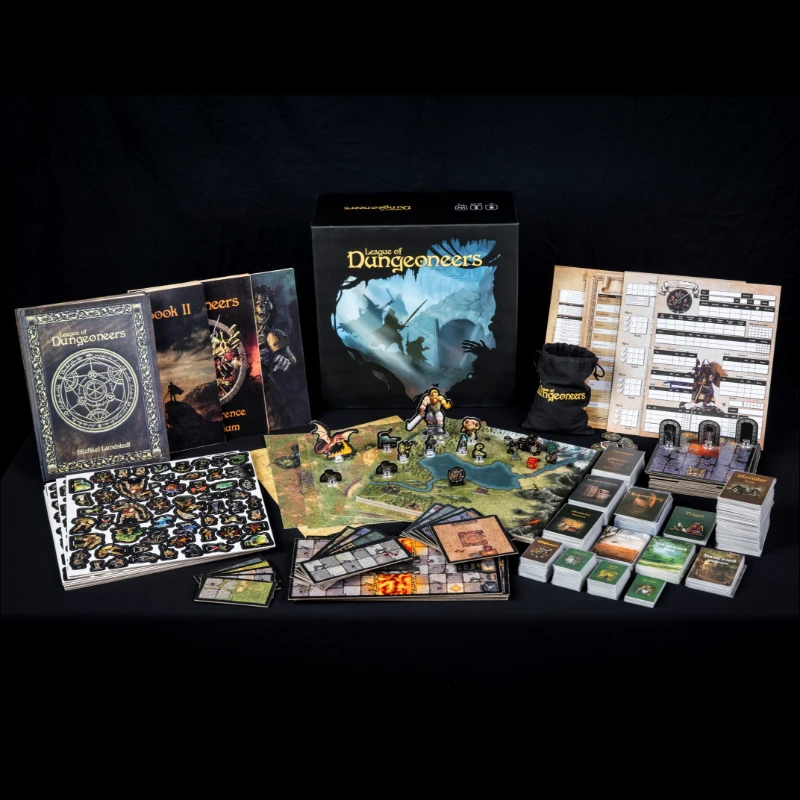
League of Dungeoneers’ components are a mixed bag. This is largely due to its printing mismatches, but I will say that beyond that, the quality is quite good. Cards are thin, yet durable. The books are good quality, with thick, glossy pages and bindings that have held up over many hours of play. The supplemental material – quick tables and quest book two, are spiral bound, so even better for quick reference.
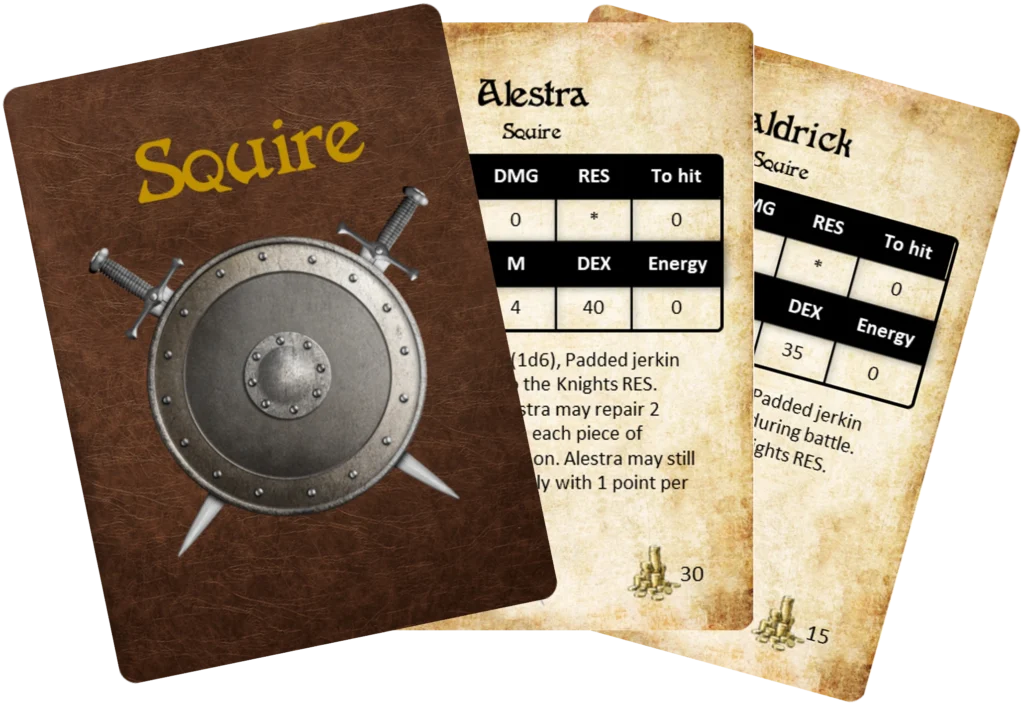
One more callout I’ll make is to the excellent standees in the game. There are hundreds. They’re double sided, labeled, and appropriately sized, and they’re as efficient as they are aesthetically pleasing. With enough to represent all enemies, player race and class combinations, and even uniquely named mercenaries, they’re a fantastic addition. Just remember to have some kind of organization system. Finding the right ones on the fly is pretty close to finding a needle in a haystack!
Expansions
Being that League of Dungeoneers has grown over the years, there have been a lot of additions beyond the core box, but many of them are included in the Knave, Queen, or King pledges that are available from the webstore. Beyond these, there are tons of cosmetic upgrades. I’ll only list some of the main add-ons I think are worth picking up, but everything from extra character sheets, metal coins, dice tray/bag and more are available on the publisher’s website.
- The False Prophet – Included in the King pledge, this is going to be the real expansion you’re looking for. Adding new rules, a new questbook, tiles, standees, and cards, it adds caves and mine tiles, with ratkin and other enemies to fight.
- Ancient Lands – Included in the Queen pledge, this add-on adds a small quest book and a bunch of new tiles that represent the Ancient Land. While the core book also has some quests in the Ancient Lands, this campaign takes it further, so it’s a nice addition for late game challenges.
- Companions – Included in the Queen pledge, this makes mercenaries available to hire. Only used for parties of less than four, it’s a nice addition to flesh out a party or for use in solo play.
- Advanced Bestiary – Sold separately, this add-on both updates and expands the main bestiary. It reintroduces old enemies and provides new ones, plus adds some new playable races, lots of lore, and some updated and cleaned up component cards along side new ones. Really it’s an update pack and expansion in one.
Voice / Art / Music
Voice
With such sparse narrative, League of Dungeoneers is not a game for voice overs, though there are plenty of opportunities for improv acting in the roleplaying, should an enterprising group of players want.
Art
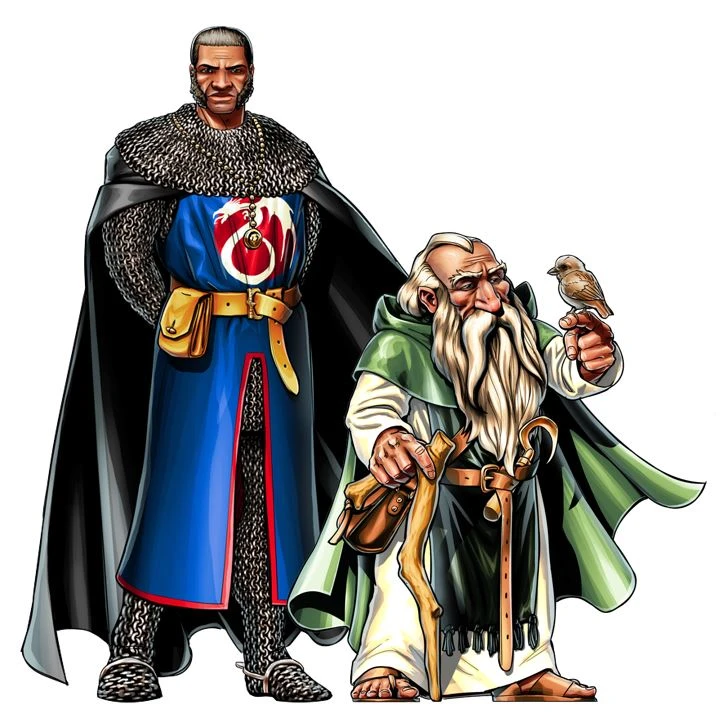
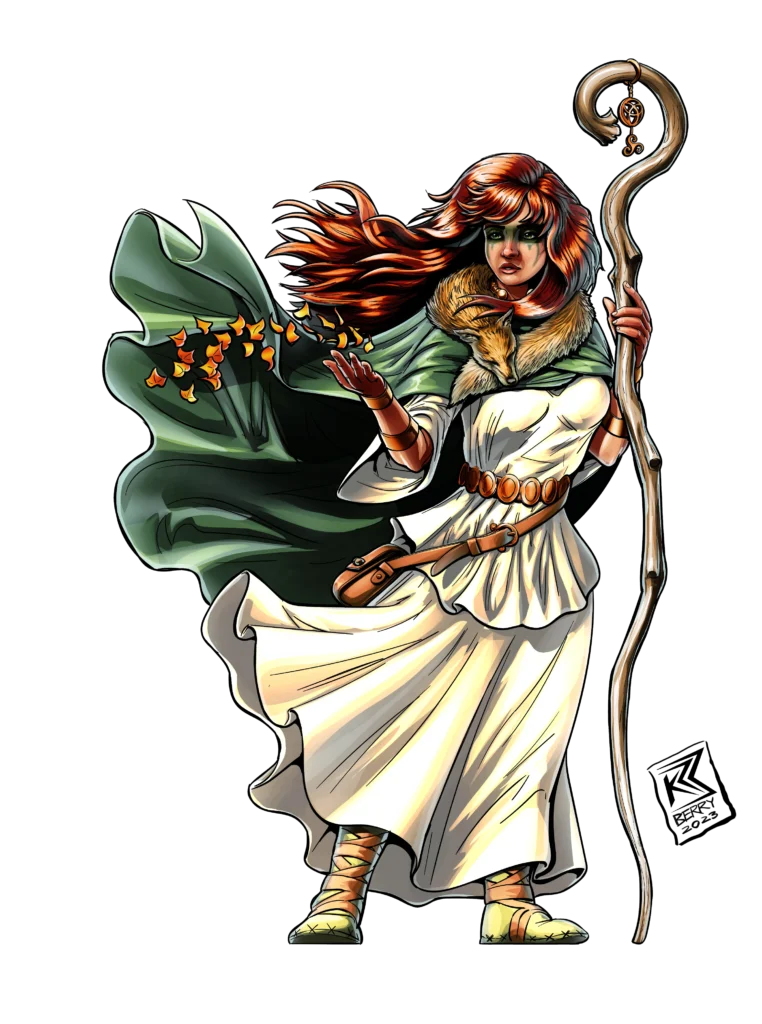
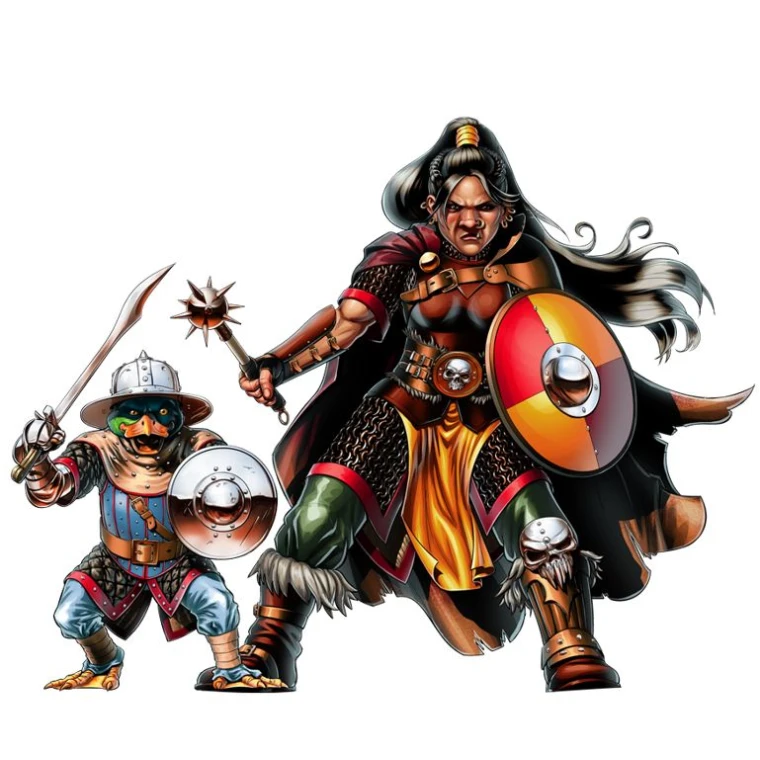
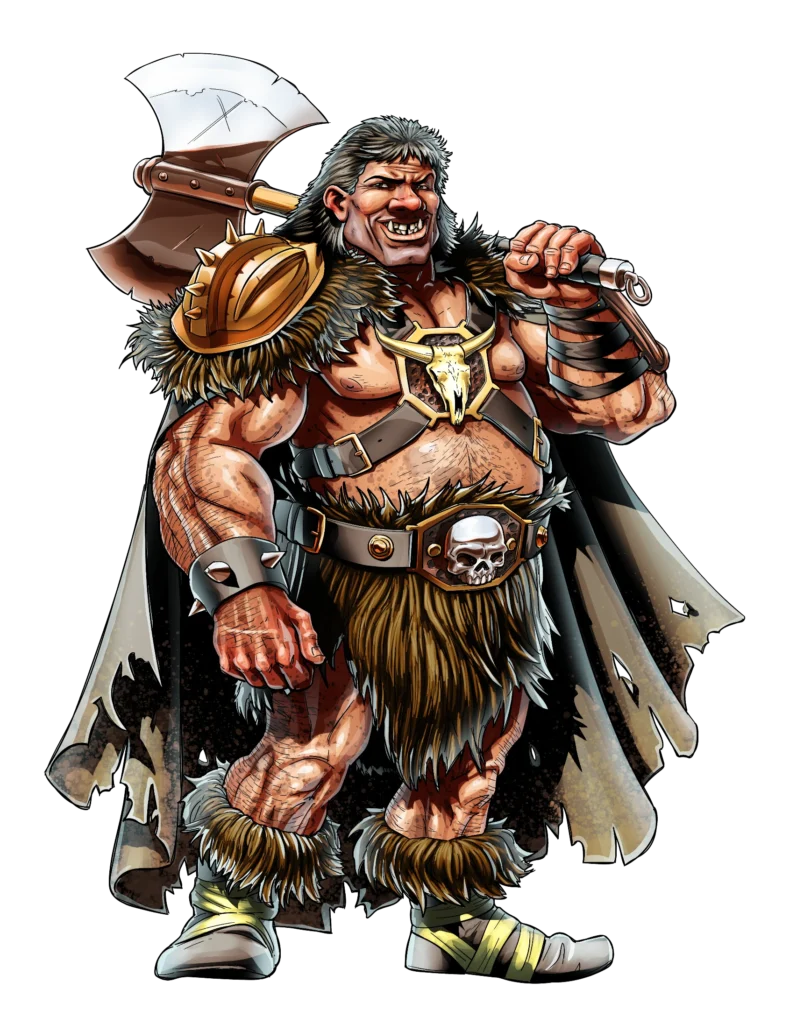
League of Dungeoneers has very little art. Some exists in the rulebook and scant little on some cards, but that’s it. It’s very much like D&D where the imagination has to go into overdrive for full effect. I don’t mind this at all, and the little art that’s in the rulebook is varied, well credited, and plenty evocative. I’ve scattered much of it around this post, for example.
Music
There is an official soundtrack, huzzah! Composed by Mans Billner, it’s a beautiful set of ten classical fantasy tracks. I’ve had it on repeat for a few weeks and have genuinely come to love it.
The Tales Told
While the written narrative of League of Dungeoneers is light, the opportunity for emerging narrative shines. Stories unfold though player action, much like in D&D.
During my first playthrough, the first quest was brutal, and my wizard went down very quickly. The mercenaries I’d brought fought bravely, but also fell, and it was up to my ranger to finish the fight with the bandits. It’s a good introduction, including to how brutal the game can be sometimes.
After another dungeon where we lost another mercenary, I both tired of paying for the fools, and our reputation was in the gutter anyway. I decided to throw a third character into our party, a barbarian named Torg. It also happened that we heard a rumor about a demonic portal below the city. It turned out to be an orc and goblin infestation primarily, with a gigantic spider den, of course… Despite doing fairly excellently all throughout, reaching the portal and finding it already flooded with demons meant it was a tall order to defeat. Due to some very unlucky rolls in a row, it turned into my first TPK!
Later on, and with a new group, we tackled several dungeons successfully. I tried out the Alchemist class, but ultimately found it a bit dull. It’s tough to consistently find all the right parts to craft enough potions to truly take advantage of the class. Retiring her in favor of a Warrior Priest, we had a much better time taking on challenging dungeons and keeping our party alive for a long time. Lots of close calls, lots of loot (but still no powerstone!), and lots of fun ensued. I quit right before becoming full fledged Dungeoneers and exploring the Ancient Lands. That’ll be a story for another time.
You Might Like This Game If…
I think this is the perfect game for someone who is comfortable with board games and TTRPG systems. The sheer volume and depth of these systems can still tease potential from even a seasoned veteran, however. Enjoy it loosely and don’t fret at misprints, or forgotten or overwritten rules.
Anyone who likes overland maps, towns, random dungeons, and campaigns, both strict and loose, will love League of Dungeoneers. Chock full of character progression, death, and creation anew, it’s almost a lifestyle game. Better have a table reserved, though, as it’s one that can sit for months on end. While it’s heavier than the old Warhammer Quest 1995 game, it still shares a lot of similarities. In fact, I’ve even heard it called a good replacement for the classic game. While I don’t know if I’d agree on that sentiment, I do think it sits along side it.
This game can work just as well for group play as well as solo, especially among those who have experience with heavy weight games. Someone should act as a DM or at least rule referee for more casual groups, however. It’s light enough that teens can enjoy it, and its themes are bog standard, old school, D&D sword and sorcery style fantasy that all can enjoy.
Score


With an extremely heavy weight, League of Dungeoneers would be a tough sell to anyone expecting a traditional board game. Held back by an overabundance of systems and lack of polish, it’s as much of a system begging for customization as it is a structured game, at least in the traditional sense. However, for anyone not afraid to get their feet wet, hands dirty, and mind utterly turned to mush spending hours in rulebooks and dungeons alike, they’re going to love what’s here.
Something about the composition of systems captivated me such that I had a hard time putting it down. Personally not put off by the rule weight, I felt like I was playing a solo version of D&D, yet with board game elements. When the dungeon crawling gameplay loop finally snapped into place, I couldn’t help but keep going for just one more room. My characters truly felt like my own, and I was sad when they died, happy to retire some, and overjoyed when the party overcame tough obstacles. This is a game I’ll most certainly be coming back to again and again, as I’ve still only barely scratched the surface of things to see.
League of Dungeoneers gets 4/5 locked and trapped doors, with a golden quill.
About the score
Review scores are out of five.
The Golden Quill award is for those games I keep in my collection, though it’s entirely possible for me to rate a game highly but not keep it or vice versa.
1/5: Would not recommend, would not play again
2/5: Some redeeming qualities, might recommend for the right person
3/5: Good game, would recommend
4/5: Great game, recommended that everyone give it a try
5/5: Perfectly achieves what it sets out to do, not to be missed