
 Tyson Heckert
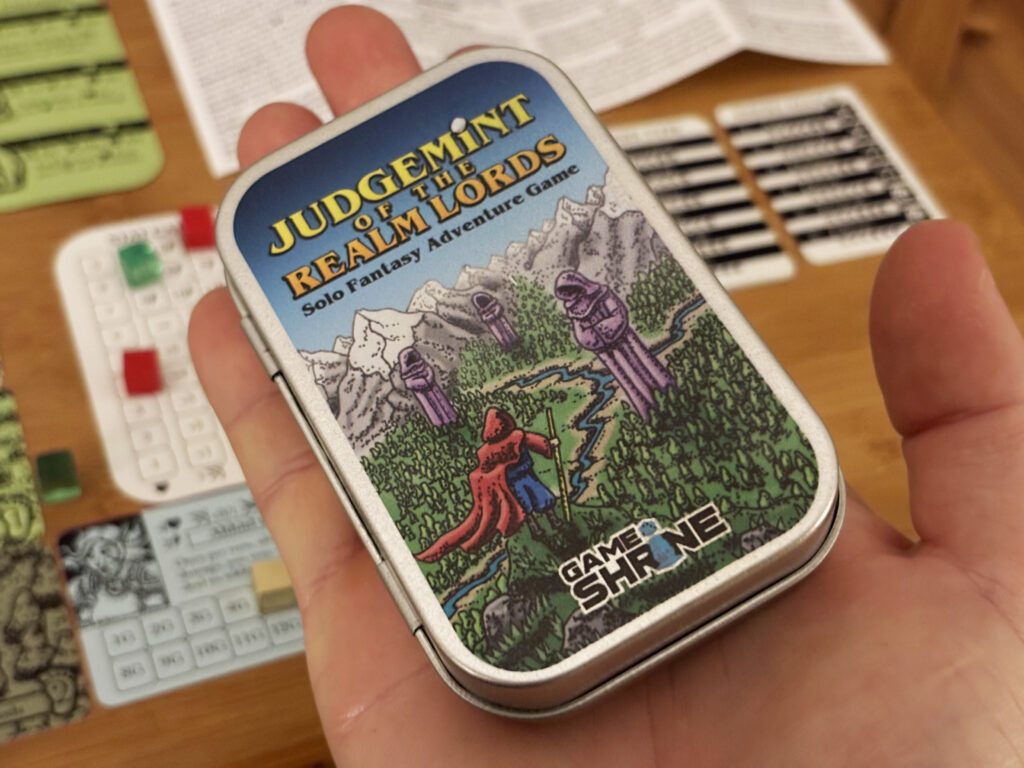
Judgemint of the Realm Lords is a very small box (literally a mint tin) adventure game by Tyler Pierce. Exclusively available through the popular print-on-demand board game site Gamecrafter, it’s not a pricey game, yet more expensive than you’d imagine it to be for its size due to its on-demand nature. Evocative of Runebound, Skyrim, Euthia, Mage Knight, and other overland exploration games, it delivers its own brand of adventure in something you can carry in your pocket.
From publisher Tyler Pierce
The Realm Lords, powerful entities in charge of governing all aspects of life, have forsaken their posts. With nothing holding them back, the forces of evil and malice have risen, causing foul denizens to spread across the land. A hero must vanquish these corrupt beings and exact judgement upon the Realm Lords.
Judgemint of the Realm Lords is a solo fantasy adventure game that sees the player controlling a hero trying to save the realm. It features a unique rock-paper-scissors combat system where players will have to predict the enemy’s behavior in order to counter them. Players can level up their hero, buy powerful equipment, and use the unique features of each settlement to raise their strength and take on the Realm Lords. Defeat 3 Realm Lords, or vanquish the powerful Death Lord, before the realm is plunged into complete chaos.
Overview
An adventure game at heart, Judgemint of the Realm Lords is going to look pretty familiar to those who like this type of experience.
Player count
Solo only, the game is meant as a solitaire experience. Cards are set out facing the player in a setup not too entirely unlike the classic game of Solitaire. This is perfect for anyone who travels a lot, or just enjoys time at their favorite third place for fun.
Play time
Written on the tin is a play time of 30-60 minutes, and I would agree with that estimation. With a five minute set up time and maybe 15-20 minutes of learning, it’s quick and easy to get into.
Gameplay
Judgemint of the Realm Lords packs an overland adventure game with light character progression and simple combat mechanics into its bite size package. It doesn’t reinvent the genre, but does have enough to set it apart that it doesn’t bore. Key to its systems are a couple important mechanics:
World Map
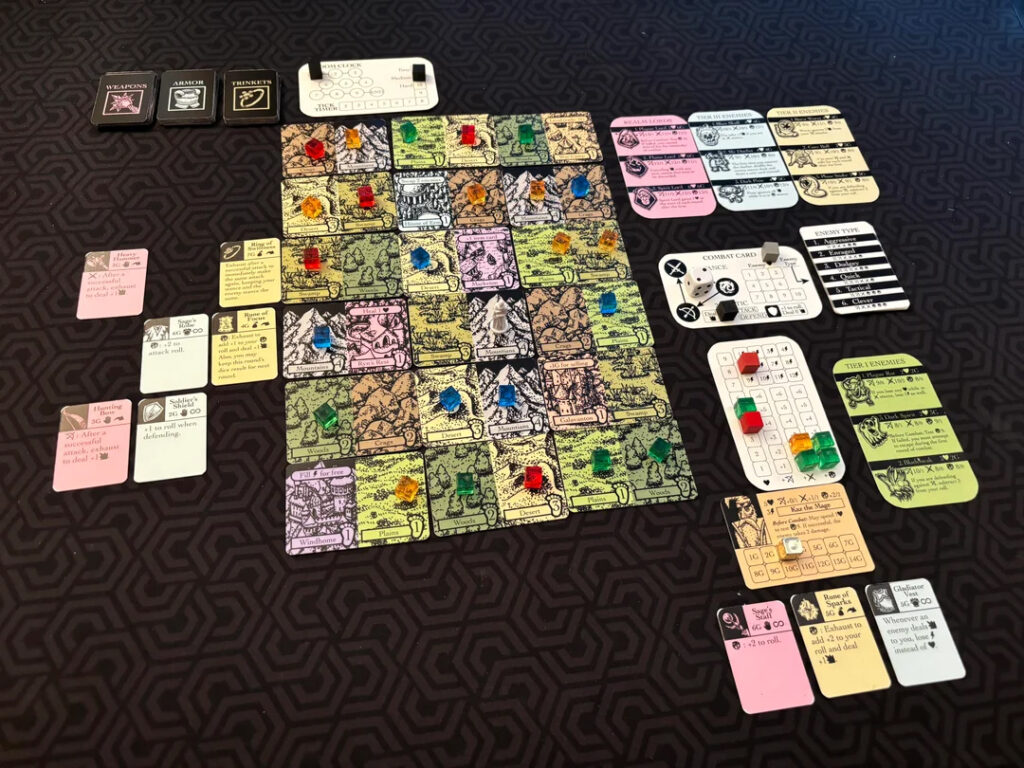
During setup, map cards are laid out in a 6×6 grid pattern to create the game world. The instructions specifically say that the game’s settlements should be independent in their row/column, such that they are never too close together. From there, enemies are seeded onto the map by randomly sprinkling colored cubes around. Lastly, some starter items are placed next to the map rows to represent a bit of what players can expect to find in that row’s settlement shop.
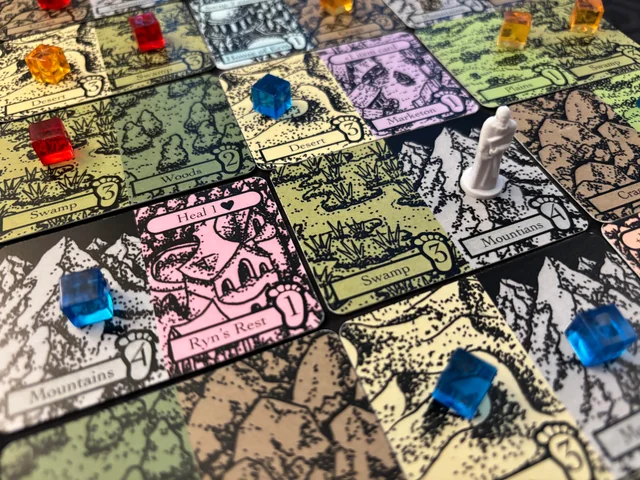
Speaking of settlements, they’re probably the most important aspect of the game. They have a special action players can use in them, so there’s more than just the shop, but the shop really is the critical part. This is because items in Judgemint of the Realm Lords can have a pretty big impact on builds. The stacks of possible item cards are larger than what the shops can have, and the shops are not refilled when items are purchased so there are a limited amount of items players will encounter in one playthrough. It’s critical that they explore all the shops to discover all the available items, then determine exactly how they want to build their characters.
Players roll to move. While I think I can audibly hear some people’s eyes doing burnouts they’re rolling so fast, it’s not all bad. Two die are rolled for how many movement points a player has per turn, unless they’re wounded, in which case they’ll move slower. Map tiles have a biome to them, and this generally influences how hard they are to move through. These biomes also nicely color the board, with tones reminiscent of old 8-bit color computer games.
Combat
When players land on a space with an enemy cube, combat begins. The color of the cube determines how strong the enemy is. Green is the easiest and red the Realm Lords (bosses). An enemy is chosen from a list at random by rolling a dice, then it’s given a type, again chosen by a die roll. This can be things like aggressive, or tactical, and will generally determine which type of stance (attack) they are most likely to perform.
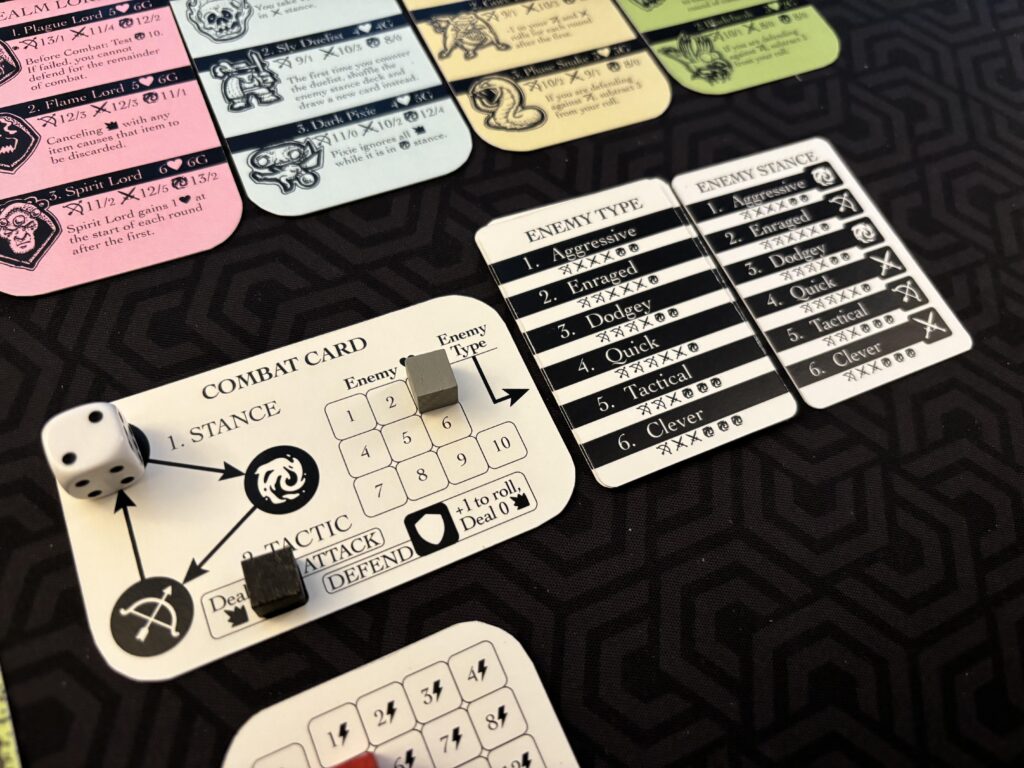
Attention then turns to the area beside the board, with the player character, their stats, and the Combat Card. To fight, players are going to begin by choosing their own stance from melee, ranged, or magic. Then an enemy stance card is drawn from the pile and lined up with the combat card. Once everything is revealed, a player can pay one energy to change their stance – wouldn’t want to be left in a vulnerable position, after all.
If the enemy or player isn’t defeated after the round, this cycle repeats. The caveat is that a player cannot use the same stance unless they pay one energy to do so. If the player has defeated the enemy, they take rewards in the form of experience and gold.
Stance Counters
There’s a bit of rock-paper-scissors going on between stances. Melee counters magic, magic counters ranged, and ranged counters melee stances. Depending on how your stance matches to the enemy, you will roll three die and choose the two best results, three die and the two worst results, or just two die. The sum of the result is added to your stance bonus, either on the character card or from any upgrades and items, and the final total is compared to the enemy’s stance total printed on their card. Winner does damage, which is a set amount that is also written on the cards, but is generally two.
Itemization and Builds
As players battle their way across the game world, they’ll be earning experience and gold. Much like similar adventure games, an enemy’s strength is equal to the experience it rewards, and a player’s current level is the threshold needed for advancing their level. This keeps the level scaling about right. Ever increasingly difficult enemies need to be defeated for advancement to continue at a reasonable pace. Players can use this experience to advance any of their stance bonuses, or their maximum HP or energy.
Gold is used to purchase equipment in towns. There are no equipment rewards for enemies, so shopping is crucial in Judgemint of the Realm Lords. Each town starts with some items revealed, and the rest are filled out when players visit. This gives a nice objective to follow, as players can see which items would be the most beneficial to them and that can drive the direction they travel.
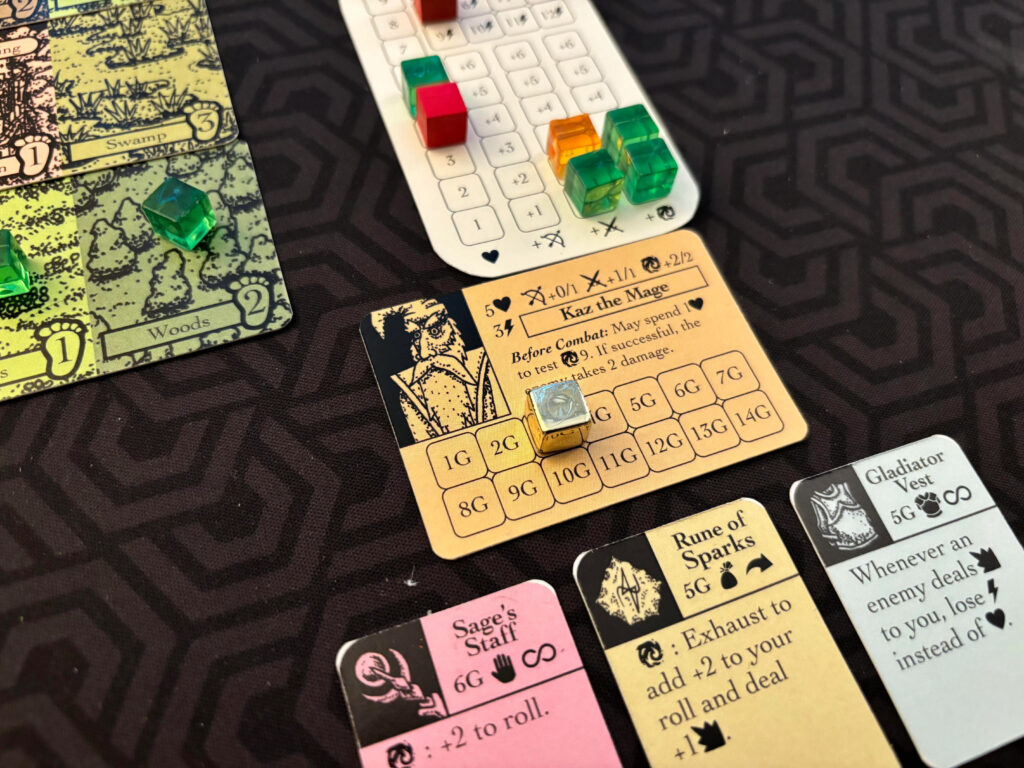
Items are relatively straightforward, mostly improving statistics or providing situational abilities like extra damage or defense, but some are a bit more complex and provide pre-battle bonuses. Building out a character to fit a playstyle, as well as adapting to what the market is providing is all part of the fun, and strategy.
Endgame
Judgemint of the Realm Lords is on a timer. Doom has a chance to tick up by way of a dice roll each turn. If that roll favors players instead, a marker jumps down the track such that Doom will tick up eventually. This track is adjustable, too, such that players can provide more or less time to play the game.
The ultimate goal? Defeat the Death Lord, or three other Realm Lords. The catch is that all red cubes on the map represent a Realm Lord, but not which one. This can mean players instantly face the Death Lord, or never. Either way, the Lords are tough, so players want to advance themselves as much as possible. While the penalty for death is not much, in fact almost nothing but a bit of lost time, time is critical since it means the Doom track presses on.
What I Like
While not as crunchy as it’s cousins, Judgemint of the Realm Lords delivers the same feeling without getting overcomplicated.
Deterministic Goals
Yes there’s a lot of randomness in this game. Yet for all that players won’t know, there’s plenty that they do. I really like that some of the town items are on display from the start, for example. This lets me pick a direction and battle enough enemies along the way such that I should have enough gold for what I want by the time I get there. Equally nice is knowing where enemies are, and the ability to skip over enemy filled tiles to pass through and land on one that I do want to fight. It is all very much like Runebound.
Character Builds
I think this is where Judgemint of the Realm Lords shines. While progression is basic, it leaves a lot of room for customization and flexibility. Characters are going to have specializations from the start, but there’s nothing locking them to that. A starting melee character can absolutely switch to magic if that’s where the game takes them. This is really cool and means the board itself needs to be considered just as much as the enemies. Players are going to need to visit settlements at an even clip to make sure they know exactly which items are available, then build out exactly what they need to win.
Variety
Since there are several characters to pick from, and more items than what players can find in one playthrough, there is plenty to discover. Not that the gameplay changes radically each time. Instead, chance is going to toss players something just a little bit different each time, and that’s something they’ll need to adapt to. It’s just enough of a reason to keep coming back for one more play.
What I Don’t Like
With a few tweaks and a little more depth, Judgemint of the Realm Lords might have been even better. As it stands, I do have a few quibbles with the game.
Strategy Balance
It’s a bit of a bummer to write this since I spoke so highly about the builds, variety, and combat. I do like the ideas behind the game’s stance system and customization options, but I was almost immediately able hash out an easy strategy.
Maximizing one stance over others is the way to go. While it’s possible to balance a couple of them and switch between, there isn’t really a need to. It’s not any stronger than focusing on one, and so the best way to win is just stick with a character’s strengths. I will say that if a player was extremely unlucky and none of the items in the shops supported their main stat, this strategy might not work, but it would be rare that no items would.
Maximization Example
So for example, if an enemy’s ranged stat is around 11, which is common, I just need to reach 11 in any stance to beat it. Lets take melee, the disadvantaged stance. If my bonus is +2 from my character, lets say +4 from experience advancements, and maybe +3 from my items, I can’t loose. Even snake eyes on the dice will put me at 11. Bosses are stronger, maybe ~15 to beat, but that can be matched with more advancement and better items.
But what about the rule saying stances can’t be repeated? Well they can, it just takes energy. At three starting energy, it means you can repeat a stance for three rounds. At two damage a round, just about any enemy in the game is defeated except for a Realm Lord. Increasing energy by using experience, or just taking an off stance turn and tanking a little damage isn’t much of an issue, though, so the strategy doesn’t change.
Obviously that’s an extreme example, but even without as much advancement in upgrades or items, focusing on one stat provides a much greater chance to beat an enemy’s combat score.
Lack of Depth
While I like what Judgemint of the Realm Lords does with its compact size, I still wish there was a little more to it. Enemies, biomes, and objective variety, especially, would have gone a long way. You won’t find dungeons, side quests, or random events here.
I had heard that the designer had a ton of these types of ideas in mind, but they all had to be cut to simplify the game enough to where it still fit in the mint tin box. That said, while this lack of depth is not really a full blown negative point for me, really more of a disappointment, it might be a bigger sticking point for some as they question why they’d want to play such a simple game like this when Runebound is within reach.
Randomization
Not to say that randomization in general is bad, but it shows up maybe a little too often here. One example is how you find the Death Lord. As I said in the gameplay section, all red cubes on the board are Realm Lords, but it’s up to the dice to determine which one shows up at the time of combat. So this could mean a much longer game fighting lesser lords, or a straight shot to the Death Lord himself. But I feel this didn’t really need to be random. I’d have preferred maybe one more cube color, purple or something. This could represent the Death Lord so that players could zoom straight to him if they felt ready.
Another example, and I’m of two minds about this, are the shop items. On the one hand, the randomization provides replayability and strategy. But on the flipside, it can be rough when items just don’t seem to be gelling with your strategy. I’d have liked a mechanic to swap an item out for one from the deck, perhaps costing gold or something.
Components
The few components in such a small tin are all great quality. The cards are thin yet sturdy, and have a nice coating that should be dirt/moisture resistant. The cubes, dice, and 3D printed player marker are all standard affair for a game like this. I don’t have anything negative to say about the components.
The mint tin itself is interesting. It really is a real mint tin, and the printing on it is a fairly heavy, likely acrylic type of paint. It holds up well and doesn’t rub or scuff easily, but would scratch, bend, or dent against something sharp. Watch your keys if you’re actually sticking it in your pocket.
Art / Music
Art
The art in Judgemint of the Realm Lords is quite nice. Very evocative of old school RPG’s on big CRT monitors when there were only a few colors available. Everything is black and white against solid shades of color. The monster, boss, and item art are all well done and standard fantasy themed.
Music
There’s nothing like a soundtrack for Judgemint of the Realm Lords, but I always have suggestions! Perhaps the ever popular Icewind Dale would fit the classically themed adventuring of this game.
The Tales Told
Well I can’t say there are a whole lot of tales in Judgemint of the Realm Lords. The emerging narrative isn’t that strong either as there are no random events or really anything narrative at all. The journey is plenty fun enough, though!
You Might Like This Game If…
Players who love adventure games will feel right at home. It’s solo only, so there’s no worry about disappointing a group, or even just searching for a playstyle or some part of the game one player may like over others. Those who love light adventuring, bashing monsters and grabbing loot as part of a run up to an epic showdown will get that experience here in a bite size package.
Just be aware that this is not a deep or heavy experience. Light on decisions, heavy on dice, and with just a little strategy sprinkled in, it’s about a 2/5 on the complexity scale. Randomness will throw a wrench in any strategy, but there’s still plenty of deterministic elements to keep things interesting. The game focuses on combat, too, there isn’t any dungeon crawling, side quests, or narrative to follow.
So obviously players are going to have a whole collection of other games to pull from in their homes already. While I don’t think Judgemint of the Realm Lords is going to trump those for a full night’s experience, this game shines the most when it’s taken out of the house. Take it to the coffee shop or the brewery for an afternoon. And it’s perfect to pop out on a trip or family vacation when there’s some downtime. It’ll probably just barely fit on an airplane tray table, or an end table in a hotel room or something. With its short play time, it’s about right as a travel game.
Score


With such a great game in a small tin, it’s hard not to like Judgemint of the Realm Lords. I love that the feeling of a bigger adventure can be found in a compact experience. It’s evocative of bigger cousins like Runebound in the best way, and that’s hard to find. Due to it’s size, I think this is the perfect game to take to your favorite third place, or to travel with. While I do wish there was a little more depth to it, and a round of balance changes to smooth out the strategies, it’s hard to deny the great time on offer here.
Judgemint of the Realm Lords gets a tiny mint size 4/5 with a golden quill.
About the score
Review scores are out of five.
The Golden Quill award is for those games I keep in my collection, though it’s entirely possible for me to rate a game highly but not keep it or vice versa.
1/5: Would not recommend, would not play again
2/5: Some redeeming qualities, might recommend for the right person
3/5: Good game, would recommend
4/5: Great game, recommended that everyone give it a try
5/5: Perfectly achieves what it sets out to do, not to be missed