 Tyson Heckert
Fallout: Wasteland Wanderer is a solo RPG in the classic video game (now TV show) post-apocalyptic world of Fallout. Published by Modiphius Entertainment, makers of many RPG systems, it’s one that they added to their repertoire perhaps a little too hastily.
From publisher Modiphius Entertainment
Welcome to Your Life on the Surface!
Congratulations! If you’re reading this, you’ve been selected to leave your vault and explore the surface! If it’s Reclamation Day, see the accompanying leaflet VLPD-11-A. This survival guide has been prepared for your lone expedition, with instructions on how to navigate the possible dangers after decades of nuclear disaster. But don’t worry, you won’t really be alone, because thanks to your Vault-Tec issued Pip-Boy, you’ll be able to record your expedition’s progress. It is imperative that you record your progress so that if your Pip-Boy is reclaimed by your replacement, they will know what to do next!
Overview
Requiring the book itself, pen, paper, Pip Boy Sheets from within the book or printed from Modiphius’ website, and two d20’s, Wasteland Wanderer has a small footprint that you could take anywhere.
Player count
This is meant for the solo enthusiast who enjoys a night in, or an afternoon out, with pen and paper, a book, and a vivid imagination. While I think this could be adapted to work for group play, there is another, far better option for that, also from Modiphius.
Play time
As with most solo RPGs, the playtime is about as variable as you’d expect. An encounter can be created and resolved in minutes, so you could theoretically play very quickly. Or, playing for hours, you could scour the wasteland and live a long, adventurous life. That is, if you don’t die horribly to the first thing you encounter. It’s open ended, and that’s the point.
Gameplay
While it is a self described solo RPG, Wasteland Wanderer leans into the story telling and journaling aspects of the medium and shies almost entirely away from the mechanical. Because of this, I actually feel it should be called a solo journaling or storytelling game instead.
Character Creation
Creating your vault dweller is the first step. The instructions that guide you through the process are well done, and you can roll up your personal avatar in ten minutes or so. Key to this process are going to be a few choices:
First, you’ll determine which vault you’re from. While the instructions mention that you can be from anywhere, including some of the famous vaults from the video games (with a list to choose from), you can also roll one up, complete with a background on the vault’s experiment purpose, population, and a special NPC you know.
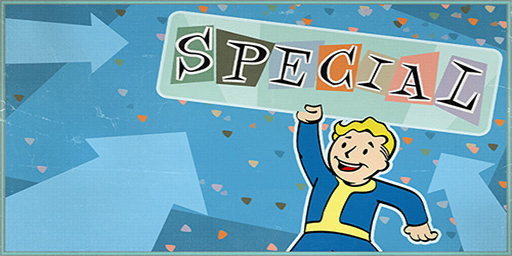
Next, the game recommends some numbers to apply to your S.P.E.C.I.A.L. scores for a proficient, focused, or balanced character. From there, skills are chosen in a similar fashion, with the game recommending some based on a background career like engineer, specialist, security, chemist, or even overseer. Players are free to mix and match all these numbers how they like, however. Attached to this are starting HP, Luck, and equipment.
Finally, and probably most importantly, players will determine their main quest. This is their reason for leaving the vault. It’s essentially a combination of a goal, what’s standing in the way of it, and where you need to go to resolve it. All the rest of the connective story tissue surrounding it is added by the player.
Exploring The Wasteland
Wasteland Wanderer takes place on a 5×5 square grid. Your vault is in the middle, and your main goal should be populated around one of the edges. Several, randomly chosen squares are determined to be blocked by terrain as well, but the rest of the wasteland is unexplored.
From there, players pick a direction and set off. Each unexplored square only requires a few minutes to “discover”. Dice determine if it’s an empty wasteland, or a settlement, and further rolls determine its Truths. It’s up to the player to figure out everything else about it, and the game prompts several questions to help. What do you see, and what’s left to see? Any monuments, defenses, or requirements to enter? What type of residents are there? How do they feel? Do they have resources, or is it desperate there? All of it is answered by the player, there’s no mechanical systems to help.
Truths are Wasteland Wanderer’s way of describing something in concrete terms, yet with no actual gameplay impact. Truths should affect everything, from how an NPC feels, to what a player decides to do in a location, what weapon they choose to use, and how effective it is. But theoretically, a player can do anything with this information.
Oh The Stories…
This is where the storytelling comes in. Every time a player enter a location, explored or not, they roll for an encounter. This can be anything from the discovery of an NPC to a more mundane find. There’s no mechanics attached to these encounters, and they aren’t even immediately deemed safe or dangerous, that’s up to the player to decide. Again, some prompts come with these, like asking what a potential enemy is doing in that settlement.
After an encounter is resolved (assuming it isn’t immediately hostile), players can take actions in the location. There’s a long list of possibilities, but they range from exploration, to scavenging, to simply patching yourself up. Even deciding to fight or run are actions, called oppose and de-escalate, respectively. Players can meet one of the NPCs they’ve discovered at the location to gain a possible side quest, or make an ally. These actions are the meat that adds the bulk of possible player interactions.
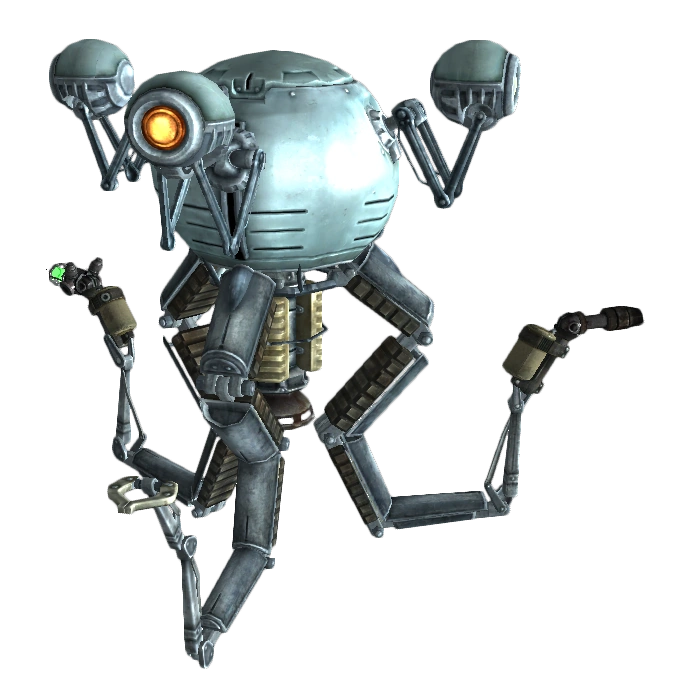
What this system does is leave the entire game open ended. A player could decide that a foe is hostile, or that it instead has information they need. It could try to rob the player, or fight the settlement, or anything the player can imagine. Maybe they discover a Mr. Handy, initially dangerous, but then becoming friendly after a successful de-escalation skill test. Even though not properly deemed an NPC, maybe the player decides the robot gives them a quest or piece of information they need anyway.
Endgame
So what’s the end of a solo RPG? The answer is it’s up to you. While Wasteland Wanderer suggests that a player’s main quest is the end of their journey, it doesn’t have to be. It’s also possible for one wanderer to die and another rise from the vault to take their place and pick up their quest. A solo RPG is not something to “beat” so much as a tool to create some fantastic stories. Think of it like making your own production, bite sized and unscripted, and largely guided by the rails the book provides, but imagined by you.
What I Like
Easily the strongest element of Wasteland Wanderer is its ability to tell a great story. It has an interesting mix of mechanics that I wasn’t expecting. It’s open ended, yet is so simple that it ends up pushing you towards your goal anyway. I’m quite an experienced Dungeon Master, so creating connective story tissue on the fly is no problem for me. For that reason, what I’d normally consider critically missing mechanics weren’t a total deal breaker here.
Strong Worldbuilding
Let’s dive into it a little bit, then. Truths are interesting component to the game. While at first I was confused as to why there’s no mechanical element to them (and I still wish there was), I did find myself using them as the primary driver to decide what I was going to do next.
For example, the weapon I had was a bent and heavy switch blade. Not very good in a fight, nor was I proficient with it anyway. I decided the truths made it practically worthless, even beyond its normal value. Once I stepped out of the vault, the very first location I entered was a wasteland sewer. Cracked and broken in all places along with the ground, either from a large bomb or just erosion over time, I decided that there may be some things to look at.
As it turned out, I found a holotape, which as luck would have it, was a quest to deliver dangerous information to none other than the cult that I was pursuing. While I figured I wouldn’t actually be completing that quest, that would be foolish of me, I figured it clued me in to how powerful the cult was, and that the sewer might have been a rest stop for their allies. Later I found institute soldiers, those that I decided were fighting the cult along side me. Since they’re hostile, I left them alone, but later came back to scavenge the area and see if I could get lucky picking up anything they left behind.
There’s enough prompt that I can make decisions and come up with reasons for why these seemingly random things are happening, and that works for me.
Journaling
Storytelling is one thing, writing that story down the way you want is something else. Wasteland Wanderer asks you to record your journey every ‘day’. It recommends not describing every detail, but rather, to weave the most important points together with further connective story tissue to tell a cohesive narrative. This is another interesting aspect that, despite getting no help from the book itself, does tease more from the player. Again, for me, this was fine, and I was having a great time trying to connect things to the cult on my first playthrough.
Fallout!
Lastly, it’s just the theme. I’m a fan of Fallout and it’s nice to see it get more attention after the success of the show. The fact that Fallout 76 is still going quite strong helps too. I like that, besides the cover, they didn’t lean too far into either for Wasteland Wanderer. Instead they stuck to the world, that fantastic post-apocalyptic playground created so long ago.
What I Don’t Like
There’s so much to say here… While my negatives may seem overwhelming, it’s only because my expectations were quite high coming into this game. I’m going to go into depth about what I feel should have been in the book, though none of it detracts from what the game still does well.
Lazy Production
Right off the top, I feel it’s worth mentioning that I found multiple spelling mistakes and grammatical errors in the book. I know that’s a bit rich coming from me when my reviews are not perfect either, but Wasteland Wanderer is not a production from a one man team. Credited in the book are two writers, two editors and a proofreader. The errors are few and far between, so hardly egregious, but for the amount of eyes (that should have been) on this product, it’s pretty shameful to see any at all.
Another thing I found odd was how often the book refers to the video games, yet offers nothing for it. It repeatedly says that players can be from any vault, or visit Megaton or Diamond City, or anywhere else, but then in the next sentence says there are no written rules for them. Players need to entirely make up everything about these settlements if they want to visit them in Wasteland Wanderer. Huh? Don’t just give me permission to have a cake but then throw your arms up and leave me on my own to source the ingredients and bake it myself. As it stands, I would never visit these locations because I have no idea how to create them in this system, or even what I could find there if I didn’t have the video games open in front of me.
Lack Of Tables
I spoke a lot about tables in my overview of what a solo rpg is, but they’re the heart of them. These are large lists of “things”, from events, to characters, weapons, and even partial conversations. The idea being that they represent the unknown, replacing a GM and a pre-written story to come together in unique ways that tell an interesting and compelling story anyway.
Unfortunately, Wasteland Wanderer’s tables are lacking. There are plenty, but not nearly enough, and worse, they have no soul. No random events exist, and there are no unique pre-made characters to discover. Story hooks and conclusions are also missing, except some vague suggestions in the world lore section. Basically, the writers took a hands off approach, giving players nothing, and letting them write every detail on their own.
What do you find in the wasteland? Distant gunfire, tracks, or something discovered in a “weird” way to name a few. Yawn… this offers nothing. Not who or what or why, or even a hint of flavor. What does “weird” even mean? Alien? Mutant? Cyborg? If I have to make it all up, why even roll on the table? The overreliance on the player to come up with everything once again comes off as lazy.
Lack Of Mechanics
I found it strange that, when reviewing the available weapons, they had no listed statistics other than a very generic number for “value”. Where are the damage numbers? Encumbrance? Special abilities? Then I realized this concept continues throughout the entire game. There are no statistics for anything. So how the heck does one even play the game?
In previous sections I’ve talked about the generation of the wasteland and what players find, but I haven’t talked about how conflicts are resolved. Basically I haven’t touched on mechanics, even combat, because there are none. The only actual mechanic in the game is skill tests. Players are asked to modify these based on Truths, or a number of other suggested factors, everything from the environment, to an NPC’s disposition. But they’re all suggestions, none of it has mechanical relevance. If a place is “damp”, what the hell does that mean? A little bit of guidance would have gone a long way.
I’ll also point out that there’s no mention of V.A.T.S. anywhere. Not even in any of the character descriptions. That’s a pretty big misstep for a game in the Fallout universe. There is the concept of Action Points, which are essentially banked successes from one test that you can apply to another, but that’s it.
Reliance On The Player
So then, to stop dancing around the question, how does combat work? To be honest, you really just make it up. Taking the “oppose” action, players roll a skill test against an enemy’s challenge rating using a suggested attribute, but anything they make up is allowed. There are further suggestions for how to modify the test’s difficulty based on a number of factors, but players are also free to make up anything they like. I can say that I want to bounce a shot off the wall and hit a tough enemy in a weak spot behind them. Making it up on the fly, I decide to make an agility test with a difficulty of 2. I pass, and now determine that I can modify the final skill test roll to defeat the enemy accordingly.
This means that, in theory, your fist, a pistol, and a minigun are the same. It’s one hundred percent up to the player to decide how strong any of those weapons are in modifying the skill test needed to defeat an enemy, or even whole groups. Now, I know the video game kind of works like this too, those three weapons can be very strong if backed up by your character, but here, it once again just feels lazy.
Art / Music
Art
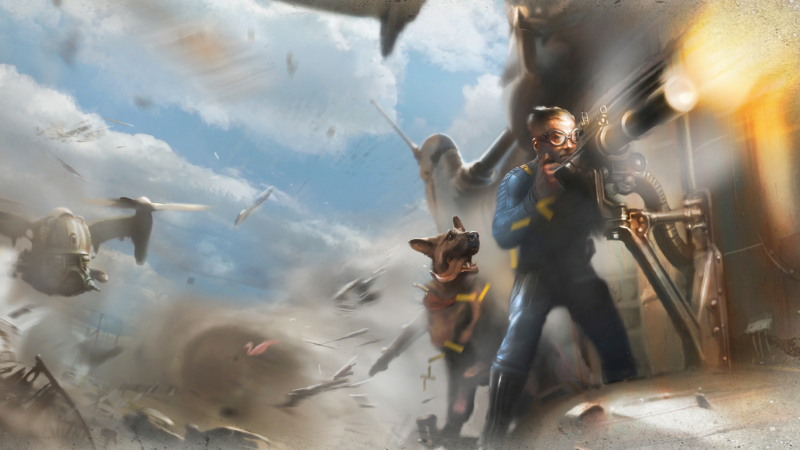
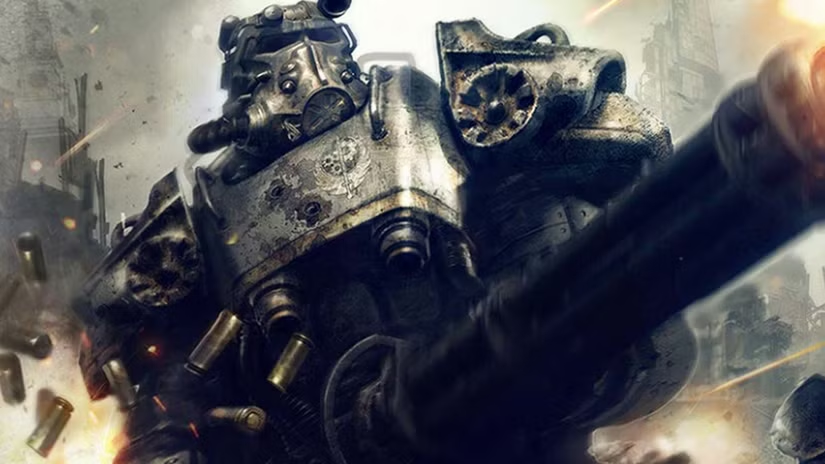
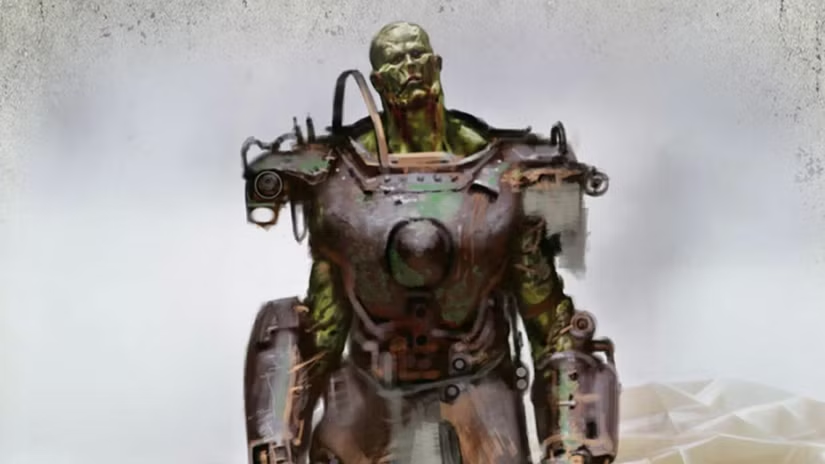
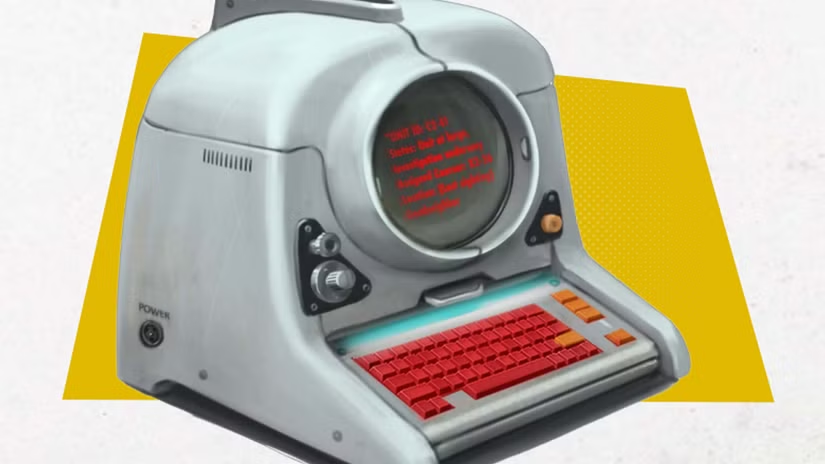
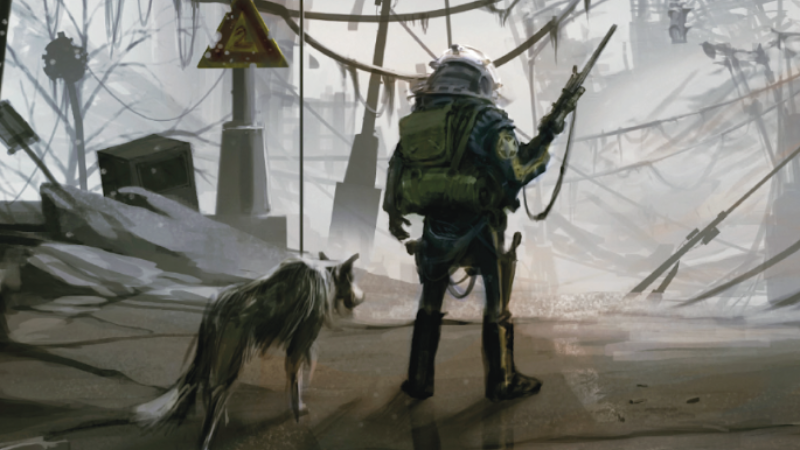
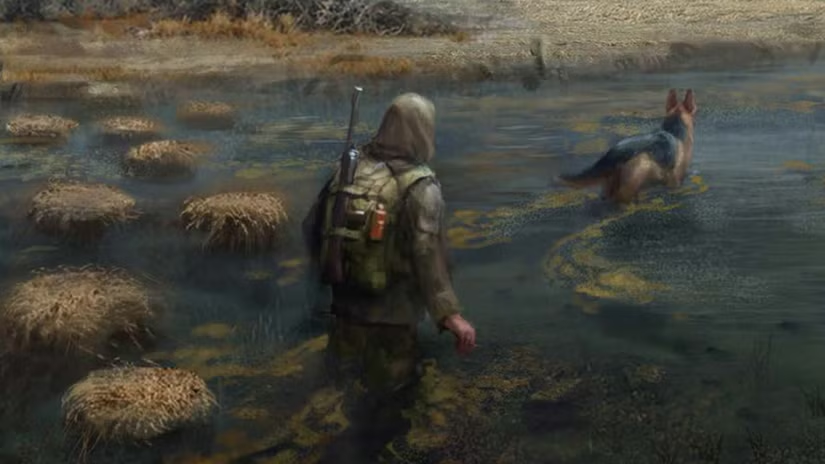
The art in Wasteland Warrior is great. While I wish they’d have done more for the cover, which is a 1-to-1 pull from Fallout 4, the rest is pretty good. Some of the pieces are watercolor style, while others are almost comic book action style. Most are new (as far as I can tell), and they’re plenty evocative of the world, not just the games or show. I like this approach, since the player will likely tell a story about their own slice of the wasteland rather than retell anything existing.
Music
Obviously there’s no music provided with the game book, but thankfully, we have a lot to choose from already! In fact, I’ll provide two suggestions: the feet stomping radio classics, and the moody tunes of exploration. I don’t think Inon Zur gets enough praise for his beautifully atmospheric tracks in the modern games. I get it, I’m usually listening to the radio stations as well, but take a gander at the other tracks, if you haven’t.
The Tales Told
This is what I want to laser focus in on. If the mechanical part of Wasteland Wanderer is practically nonexistent, the story engine shines. There’re a lot of opportunity for interesting narratives here, and the pieces come together surprisingly nicely. Again, there’s a lot of imaginative input needed from the player to do this, but I was able to come up with several compelling stories that could never be told in a structured medium like a board game.
Having journaled them, I’m in the process of dramatizing one that I’ll post here when finished.
You Might Like This Game If…
For someone to get the most out of Wasteland Wanderer, they need to come to the game with an understanding of what it is, not what they expect from it. This is a journaling, storytelling engine first, and a game second. I can absolutely see someone picking it up with wide-eyed expectations of deep mechanics, tons of random tables, and all sorts of interesting quests, events, and characters, just to be disappointed and walk away confused.
With that in mind, those that are willing to put in the work to create stories in their own personal slice of the wasteland might find something pretty compelling about the way the pieces come together and their mind fills in the blanks. There is enough grey space that players are encouraged to jump in and fill it as they see fit. Two seemingly unrelated finds can suddenly snap together when your mind reaches for red string to connect them, like a conspiracy theorist on a rampage for the truth.
As an aside, while this is a solo RPG, it’s systems are so wide open that I’d imagine an enterprising GM could use them to help create stories on the fly. There’s an actual Fallout RPG for group play, however, so I wouldn’t just get Wasteland Wanderer for that, but my point is that the book can be useful in more ways than one.
Additionally, while the game does not have an official content rating, I did not discover any rough language, suggestive themes, or anything that would be off-putting to a younger audience. There are Chems, largely performance enhancing drugs, but they’re all made up for the Fallout universe and do not represent anything particularly harmful.
Score


Mechanically light and with some missed opportunities to inject the soul of Fallout’s standout stories into a solo experience, I still like what Wasteland Wanderer does. The story engine and journaling aspects shine, even though they depend on the player for detail and flavor. With a little work from my own imagination, what came together on the pages of my Pip Boy Sheets was something really cool, and for that reason alone, I think I’ll be hanging onto the book.
If my criticism sounds harsh yet my score is somewhere in the middle, that’s on purpose. Wasteland Wanderer is not what I expected it to be, nor is it what it probably should have been. Yet at the end of the day, it does achieve a goal, even if it’s not the one players might have wanted.
Fallout: Wasteland Wanderer gets a moderately radioactive 3/5 with a golden quill.
About the score
Review scores are out of five.
The Golden Quill award is for those games I keep in my collection, though it’s entirely possible for me to rate a game highly but not keep it or vice versa.
1/5: Would not recommend, would not play again
2/5: Some redeeming qualities, might recommend for the right person
3/5: Good game, would recommend
4/5: Great game, recommended that everyone give it a try
5/5: Perfectly achieves what it sets out to do, not to be missed