 Tyson Heckert
Overview
From publisher Ankama
History is full of secrets…
As they explore an ancient Egyptian tomb, a team of archaeologists and adventurers stumble upon a mystery that History forgot. To uncover the truth, they will have to delve deeper and deeper in the pyramids, dodging deadly traps and fighting back swathes of monsters running after them. Has the old Pharaoh placed a curse on this expedition? Should some secrets remain untold? This story is now yours to complete…
Arkeis is a cooperative, story-driven, campaign game with minis set among ancient Egyptian ruins.
Each player takes control of an adventurer as they explore a modular board.
Players have up to two actions per turn: search, move, assist an ally or fight one of the numerous dangers waiting for them in the tombs! The results of their actions can be altered by the equipment and character upgrades they earn during the campaign.
They can push their luck at the risk of being cursed or suffering lasting traumas from injuries!
Each character has their own backpack to store their items (and curses) between adventures.
Each scenario has objectives that the players will try to accomplish during the game to earn rewards in the form of key items and upgrades that influence later scenarios.
It will take a team of skilled players to reveal all of Arkeis’s secrets!
Created by French studio Ankama, Arkeis is a Kickstarter funded, cooperative story-driven campaign board game. It’s a component heavy, gameplay light adventure with legacy elements, where players explore a steam-punk, fantasy inspired version of ancient Egyptian ruins.
Player count
For 1-5 players, or with at least two characters for solo play, Arkeis works well at any player count. Gameplay is simple and doesn’t break the mental bank, so a full party of characters could be played solo, and a full table of players won’t be stuck in analysis paralysis or turn to their phones in boredom.
Play time
Supporting both campaign and randomly generated, single scenario modes, Arkeis’ scenarios take around 1-2 hours to complete. The campaign mode has ten scenarios, two of them offshoots of others, and one prologue. This means a full campaign might take ~15-20 hours to play. Considering the random scenario mode, the game could theoretically be played forever, but with limited options for it, it’s likely just a few more hours of play can be squeezed out of it.
Gameplay
Easy to pick up, Arkeis takes about 30 minutes to learn, just a few minutes to set up, and is easy enough that anyone can enjoy it.
Setup
Taking a page from other games like Cthulhu: Death May Die, Arkeis has scenario boxes hiding the cards, enemies, and special rules necessary for each. Then it has tuckboxes for each character, plus one for the group’s campsite. This not only saves progress between scenarios, or when boxing up the game for another time, but is also a convenient place to put tokens earned throughout the campaign.
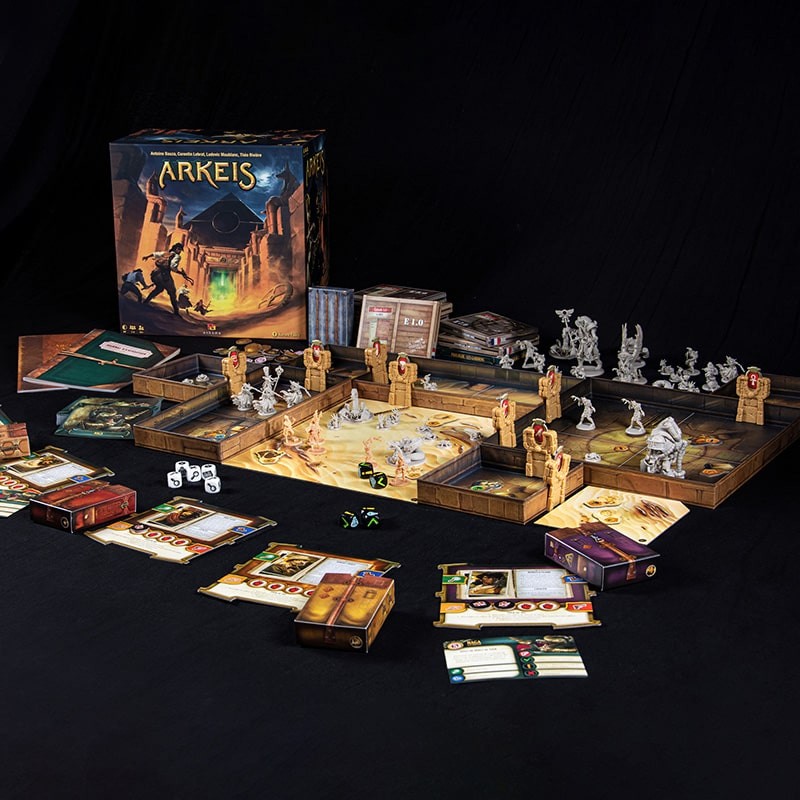
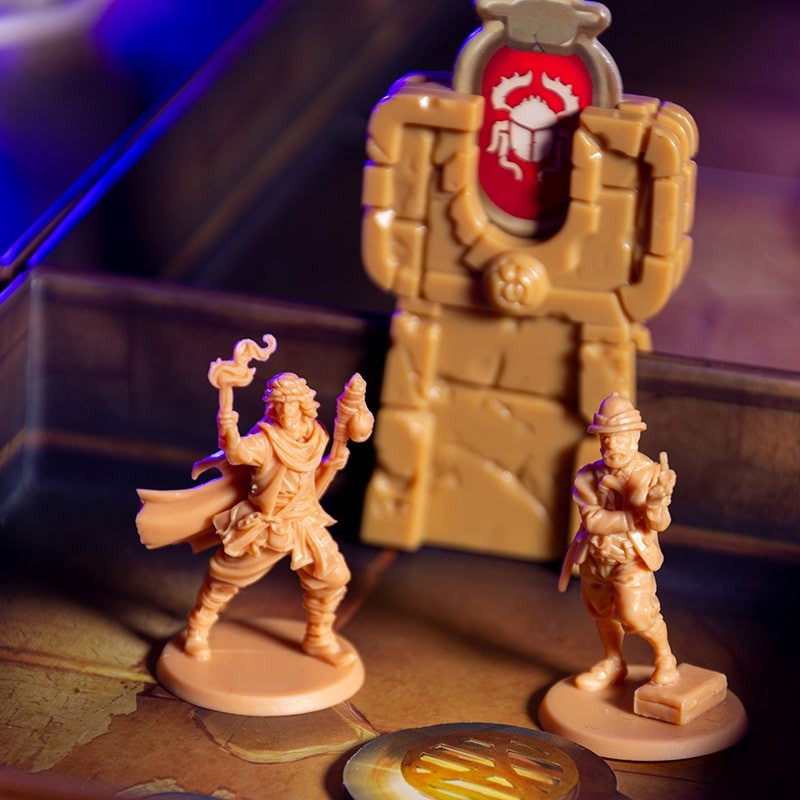
Perhaps most notable about Arkeis are its fantastic components. Besides the wonderfully done miniatures, the game comes with tiles, then “trays” that represent parts of various tombs. Doors are plastic pieces that slip over the tray walls, and those doors have crown slots for tokens to denote which card to pull for each door’s challenge.
While visually impressive, the setup is actually about on par with other dungeon crawlers. Tiles and trays are labeled, arranged according to the scenario description, then doors, searchable elements, enemies and other unique elements are placed to finalize setup.
Scenario Cards
Starting a scenario means pulling the elements for it from the labeled tuckbox. Inside are cards that represent everything a player can discover, from useful items to deadly traps, enemies, hidden doors, and much more. Some of these even evolve the campaign, adding enemies, items, or special effects to existing card stacks and character inventories.
During play, points of interest around the board correspond to scenario cards by matching color and symbol. These form the bulk of the adventure and make it come alive. Players often don’t even have a good idea of how to complete their objective at first, so it’s important to spread out around the tomb and explore every nook and cranny.
Actions/Combat
Each character takes just two actions on their turn. There’s the standard, expected array: move, search, open a door, trade, and fight, most notably. Combat in Arkeis is interesting. Enemies act more like obstacles or hazards than roaming creatures bent on a player’s destruction. Their objective is to slow players down, as the only real way to fail Arkeis is to run out of time. Each has something it does on player activation, and while this can be to move around the board and/or damage players, most will stand in place and simply get in the way.
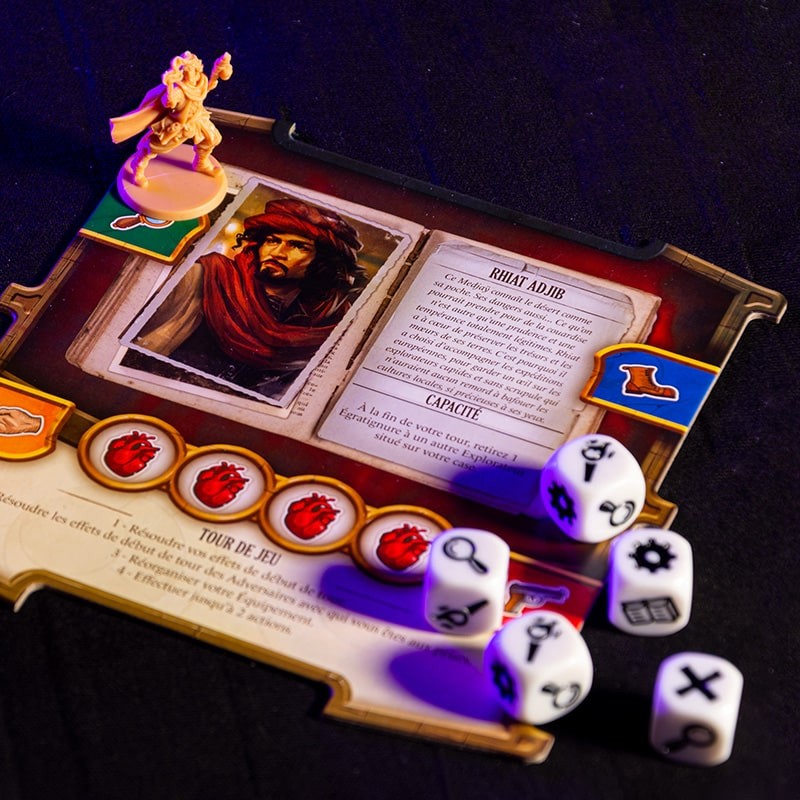
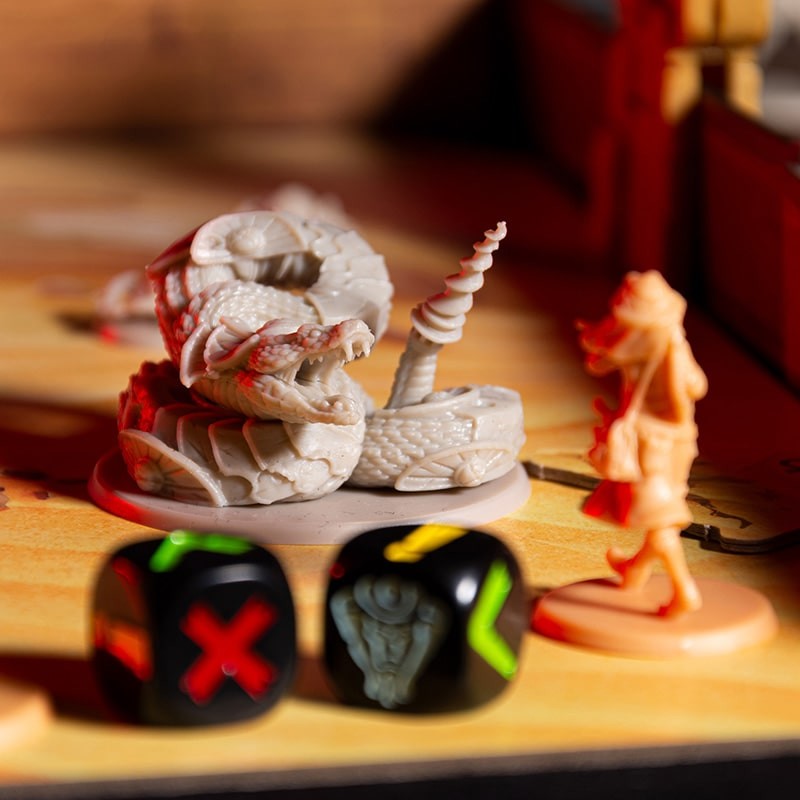
Listed on an enemy’s card, then, is what it does in response to the player’s action. If a player tries to move away from a space with an enemy on it, it could damage or slow them. When searching a zone full of enemies, something similar. That brings us to actual combat. Players roll two die modified by items or abilities, and the results are checked against the enemy’s reaction. Positive results can damage or defeat an enemy, while negative results usually damage the player, and middling results are somewhere in between. Finally, there’s a push-your-luck result, costing one of Arkeis timer tokens in order to count as a success. Character abilities can also cost these tokens, so this is one of the game’s most interesting aspects: when do players run down the scenario timer in order to defeat enemies faster and/or use their abilities?
Fail Forward
It’s not actually possible to fail Arkeis. Characters cannot die in combat, instead gaining Trauma, negative effects that slow them down. The only way to gain the negative ending to a scenario, then, is to run out of time. This doesn’t stop progress, however, instead only changing the story outcome and rewards. This is an interesting concept, one that leans into what I think Arkeis is trying to achieve: a low stakes, continual drip of adventure and fun. Because of how punishing the random nature of its systems can be sometimes, it’s one that I think works.
Collectibles & Legacy Aspects
During a scenario, players are sometimes asked to roll and record the results of investigation die. This means they’ll open the scenario book and cross off any space they earn. Collect enough results and gain a reward, whatever the row/column denotes.
After each scenario, players take the win/loss and event stickers they earned place them in the designated slots in the scenario book. Then when returning to camp, they earn and construct new tents, also stickers, that go in the campsite spaces of the scenario book.
Players will keep some scenario tokens as mementos of their actions, and those can have an effect later on. They keep any items they earned, but also keep Trauma. While there are ways to heal Trauma, it never feels like there are enough, so players will be constantly on edge with which ones are the worst and need to be prioritized.
What I Like
Arkeis has a lot going for it. I was pleasantly surprised by the scenarios, especially their themes, and I had a great time evolving my characters between them. While gameplay initially seemed a little too simple, it quickly turned puzzle-like when more difficult scenarios presented unique challenges, and my characters mounting trauma held back more obvious choices to resole them.
Scenarios
So Arkeis’ scenarios are fun. They aren’t mind blowing or anything, usually revolving around finding keys or defeating enemies, but it’s cool to explore the tombs and discover what’s hidden in them. Later scenarios start to get wild, with everything from mechanical scarab factories to a massive runaway elevator, ending with the final showdown in the mega-tomb. Challenges – both combat and non-combat – are enough to make a player think, but not overthink. Even though there’s some gotchas that don’t always feel fair, I think the low-stakes nature of the game kept it from feeling too bad when I’d gain the negative ending to a scenario.
Luck Mitigation/Fail Forward
There are a lot of random elements in Arkeis. Some things are deterministic, but especially when it comes to combat and Trauma, they’re random. Poor combat results can cause damage to stack up, and a bad Trauma can further effect these results, causing a cascading failure. Nevertheless, earnable re-roll tokens, the push-your-luck side on the combat die, and unlockable character abilities all help. I found the sum of these to be just enough mitigation to prevent the combat from being frustrating.
In the end, however, winning or losing in Arkeis doesn’t matter much. Regardless of which outcome they get, players move on, applying the appropriate sticker to the scenario book and continuing onto the next. While this can lock them out of some unique rewards, it never stops progress.
Ease of Play
It’s clear that a core tenant of Arkeis is it’s accessibility and ease of play. There’s very little complexity to the player turns, instead focusing on the group strategy. On a character’s turn the most important decisions are usually what to do with the two actions they have, and how their abilities, traumas, items, and engaged enemies affect that.
I find this idea a pretty good fit for this style of game. It’s easy enough that it doesn’t cause analysis paralysis, and something that anyone, even kids or families can enjoy. While playing, I liked that I didn’t need to overthink what was going on, even solo with multiple characters. While I do think there probably should have been a little more to the game’s exploration, maybe some skill checks, or even just more to do with the interaction points in the scenario, it’s fine that there isn’t because if they’d have gotten in the way, they’d have landed in my negative category.
Incredible Production
Arkeis is a really cool looking game. It’s a simple enough idea that an art wrapped tray could thematically represent a building, and simple plastic doors that hook on the edges of these trays provide an actual 3D door. But I also need to shout out the fantastic miniatures the game has. They definitely did not need to be quite so elaborate or exquisitely detailed as they are. For a game like this, an old Fantasy Flight chunky style could have worked here, but the fact that the miniatures are so well done is icing on the cake.
It’s also super cool that players have “backpacks” to store tokens across play, or when packing the game up. I love the individual scenario boxes as well, and it’s cool that the few base components are reused to such a high degree simply by changing the scenario cards and what they represent. There’s no need to have thirty different tokens with all kinds of shapes and art when one can mean anything, letting the scenario card do the heavy lifting.
What I Don’t Like
I think a bit of streamlining and rework around some elements of Arkeis could have smoothed the pain points I have, and brought the game up quite a bit. I don’t think any of my negatives are deal-breakers, but they do hold the game back from one that I’ll keep in my collection.
Trauma Spiral
First is the snowball effect Trauma has. I get what it’s going for, especially around slowing down characters to indicate tension, but it rears its head at all the wrong times. Yes, Trauma is somewhat mitigated by powerful character abilities, but overall, it gets in the way of the fun. Some enemies are difficult enough that players will gain a significant amount of trauma from them no matter what they do. Often weakening them to a significant degree, being unable to move, fight, search, or use their abilities effectively, if at all, means they’re neutered to the point it could affect the scenario outcome. Your combat focused character may suddenly need to re-roll their successes, an explorer character may be stuck unable to move without assistance, or they’re unable to open doors anymore. Yet in a tightly controlled challenge against time, these are what players need to succeed.
While there are ways to heal trauma, there aren’t enough. They carry over between scenarios, so players are often going to find themselves with some trauma of some type, pretty much always. I get that mitigating the worst of these effects is also part of the challenge, but progress then feels like two steps forward and one (or two) steps back, and that’s annoying.
Hidden Knowledge
I have to mention this because Arkeis follows down the same problematic path that I have with many other games of this nature. The idea is that players won’t know what they can find in a scenario until they stumble upon it. This usually extends so far that even the objective of a scenario isn’t clear until getting further into it. It’s neat on paper, but it means there’s a lot of stumbling around in the dark and making mistakes, either opening something that releases enemies, or finding a lock that needs keys, or getting stuck somewhere.
But here’s the problem: the game is on a timer. So every time players find something good, they feel like they’ve progressed. Every time they find something bad, it feels like a gotcha. And every time they need to backtrack, get slowed down by enemies and fail the mission, it feels like they were setup for failure. Of course, playing a second time would mitigate some of this, but Arkeis is a legacy game, there is no second chance.
I have a big problem with this because for a game that prides itself on simplicity, and fun, this is not fun. While I’m not quite sure how to get around this issue without significant reworks, and I don’t want to take away the concept of exploration and discovery, the constant lack of any clues really gets to me.
Lack of Depth
I’d have liked to have seen a little more to the Arkeis’ systems. More dice interaction, perhaps a way to push and pull the scenario’s Fate tokens back and forth based on results, more push-your-luck elements, and more ways to add die or change results. Some way to search beyond just what is in a scenario would have been cool, as I’d never know the deference between a rope in scenario 1 or 7 anyway.
Legacy Aspects
While I do like some legacy games, I’m not a big fan of them overall. I get that the concept of one-time use components creates a unique experience, but it had better be pretty mind-blowingly memorable for me to feel like the component destruction was worth it.
In Arkeis, I don’t feel that the legacy elements were necessary. Search progress could have easily been a set of tokens to compare to the book’s requirements instead of writing them in, and stickers for scenario results are unnecessary. Finally, camp structures could have been tokens or cards, perhaps arrayed on a separate board, or even just laid out on the table.
The worst part about all of this is that the game’s reset booklets (additional sticker books to play the game again) are sold out everywhere, unlikely to ever be reprinted again. I can see players wanting to play the campaign again, however, especially with the hidden knowledge involved. My suggestion is to write everything down on paper instead of use any of the legacy elements.
Components
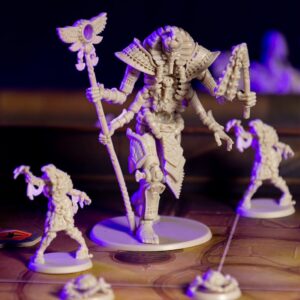
This is one of Arkeis’ best aspects. With 53 miniatures, all with exceptional detail, posing, and in strong, hard plastic, they’re top tier among their peers. Maybe not quite to Games Workshop standards, they’re still some of the best in class.
I’ll reiterate that the plastic doors and cardboard tray combination representing the tombs is fantastic. It’s a subtle combination of paper and plastic that comes together in a really eye catching way.
Voice / Art / Music
Voice
Unfortunately, no voice over for the bit of scenario narrative exists. There isn’t that much of it, however, so I think players won’t have an issue reading it to a group. The little bit on the cards as the scenarios unfolds is equally light.
Art
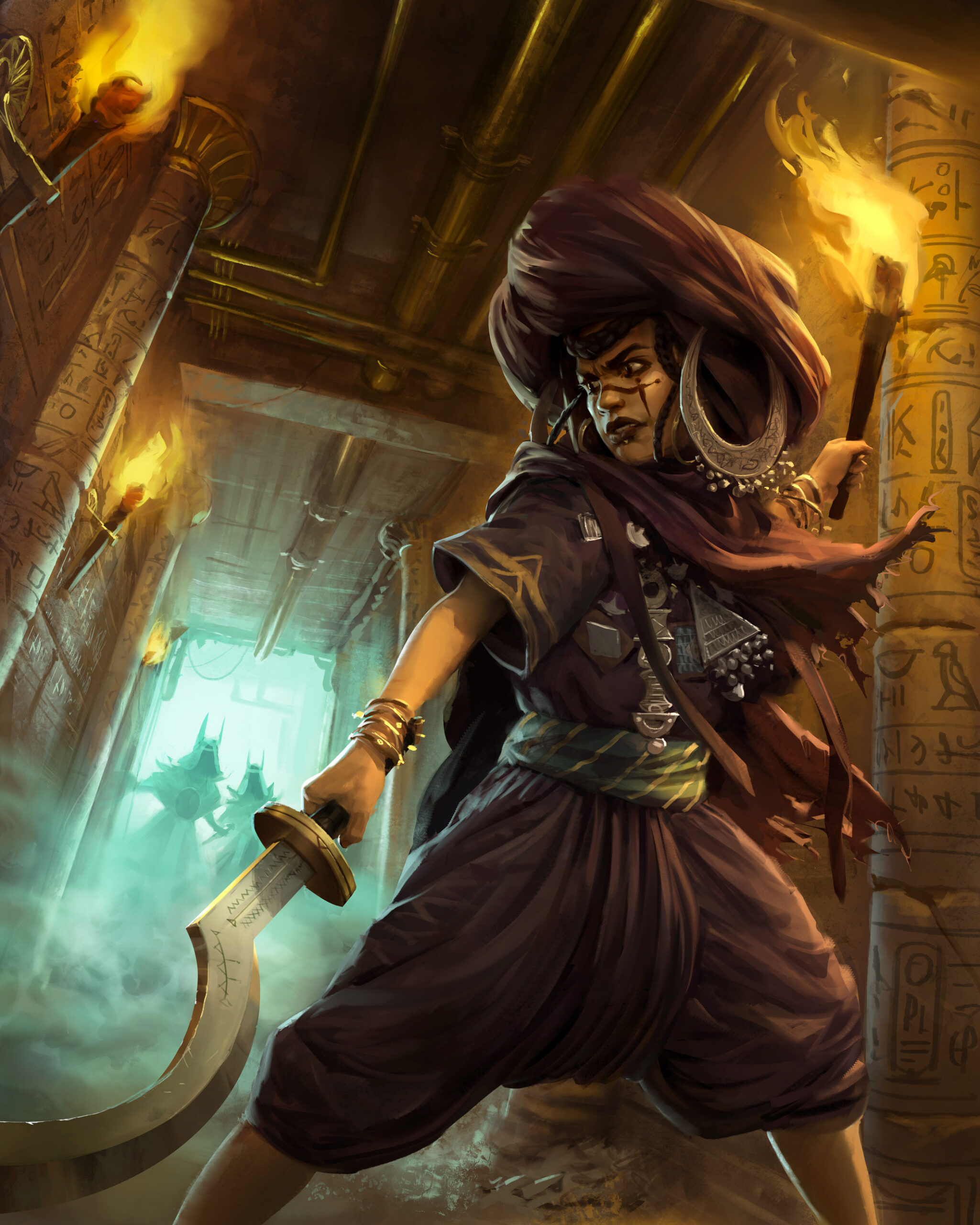
Arkeis’ art is top notch. Cartoony, colorful, easy to read, and thematic, it hits the mark. The few large pieces are reminiscent of a Saturday morning cartoon or comic book, and I love admiring them. While character, enemy, and item art is in a slightly different style, it all fits the theme and presents well.
Music
No official soundtrack for Arkeis exists, but I might suggest some fantastic desert themed tunes for it.
I know what you’re thinking: Homeworld? Yes, and because Arkeis has steam-punk elements to it, I think it works! Give the soundtrack a whirl and see what I mean.
The Tales Told
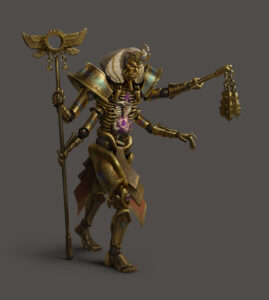
While the written narrative of Arkeis is quite basic, I’ll talk a little bit about its themes and overall direction. Explorers find themselves investigating tombs, but quickly realize they’re not normal. Ancient traps and mechanical scarabs emerge to thwart them. If that wasn’t enough, bandits, zealots, and ancient guardians all appear to stop what the team is doing.
Eventually, investigators discover an ancient scarab making factory, discover the secret to the Sphinx’s riddles, get stuck on a runaway elevator deep into the earth, and finally confront The Avatar in the Black Pyramid. It’s a pretty epic adventure in a less than ten scenario arc.
You Might Like This Game If…
Players who like light gameplay, exploration, minimal combat, cool themes, and a great looking production will love this game. Think of a lighter, easier to play version of Cthulhu: Death May Die with campaign and legacy aspects. Since players cannot die, the campaign is fail forward, and the real enemy is the scenario timer, there’s fairly low stakes to the overall decision making that keeps the game moving.
On the flipside, experienced gaming veterans may find the game lacking. Anyone who doesn’t like legacy aspects may be turned off too, as Arkeis’ campaign is meant to be played once. Those that find hidden knowledge, scenario timers, and lack of stakes frustrating might shy away from the game. I’d look closely at some gameplay, or hone in on the fact that individual decision making it light, but group strategy needs to be strong to succeed, then decide if the game is worth picking up.
Score

Arkeis was a fun time. Light and easy to play, I enjoyed the merging of ancient Egypt and steampunk themes. The scenarios were varied, thematic, and balanced well enough that I won about half of them. Since outcomes don’t matter, while a bummer, I never felt too bad when a bad gotcha, bad dice roll, or lack of information was the culprit of a negative outcome. I was able to enjoy the game for what it wanted to be: an incredible looking, quick playing and fun adventure game.
While some negatives like hidden knowledge, frustrating Trauma spirals, and needless legacy aspects got in the way, they weren’t deal breakers. I found the random scenario mode fun, but it didn’t bring quite enough depth with it for me to keep coming back to the game. Arkeis isn’t a game that I’ll be keeping in my collection, But I do wholeheartedly do think it’s worth checking out, even if just to enjoy the spectacle of it for the brief time that it shines.
Arkeis gets 4/5 mechanical scarab beetles without a golden quill.
About the score
Review scores are out of five.
The Golden Quill award is for those games I keep in my collection, though it’s entirely possible for me to rate a game highly but not keep it or vice versa.
1/5: Would not recommend, would not play again
2/5: Some redeeming qualities, might recommend for the right person
3/5: Good game, would recommend
4/5: Great game, recommended that everyone give it a try
5/5: Perfectly achieves what it sets out to do, not to be missed