 Tyson Heckert
Overview
From publisher Dragori Games:
Experience the thrill of classic dungeon crawlers, infused with great strategic depth, in a unique dark desert fantasy setting. Find immersion and nostalgia in the intense battles that only the bravest souls dare to explore. With straightforward rules and innovative mechanics, every encounter is unique—you will never know what lurks within the shadowy pits of the dungeons.
Make a pact with a demon lord and combine your attacks with the demon’s, creating a unique combinations and gameplay for each hero. There are dice rolling, but the powers allow to mitigate the luck with good strategy.
Explore the dungeons to find artifacts and hidden secrets, with an exciting loot system. Many items are unusual and make real impact on the hero’s powers. With luck, you can find the set collection for your hero and become much more powerful.
Make tough choices, including moral dilemma and shape the campaign. Your choices will shape the world and determine the ending.
Odalin: Dungeons of Doom is a dungeon crawl board game with a larger narrative wrapper than most. Crowdfunded on Gamefound in one print run, it had an ambitious timeline for the promise of a large amount of content. While I’ll only be covering the core game in this review, I’ll mention some of the available add-ons as well.
Player count
Supporting 1-4 players, soloists still need to use at least two heroes, or a full party of four with a set of supplemental rules to simplify some of the other hero turns. I haven’t tried the simplified version, instead playing two handed solo where I think the sweet spot is. Since the game has many things to remember, including out-of-turn actions, it will probably overwhelm casual players at higher hero counts, so running a full group of four is best left for a game group of four players.
Play time
Odalin’s campaign is massive, running ~100+ hours to complete all five chapters. Following a recent trend among its peers, a chapter is split into: 1. A narrative introduction, complete with branching story choices and a check sheet to mark decisions. 2. The dungeon itself, split into rooms connected by door tokens.
After a series of rooms, players arrive at Sanctuary checkpoints. While each room’s fight may take 20-30 minutes, the string of rooms between each sanctuary might take 2-3 hours.
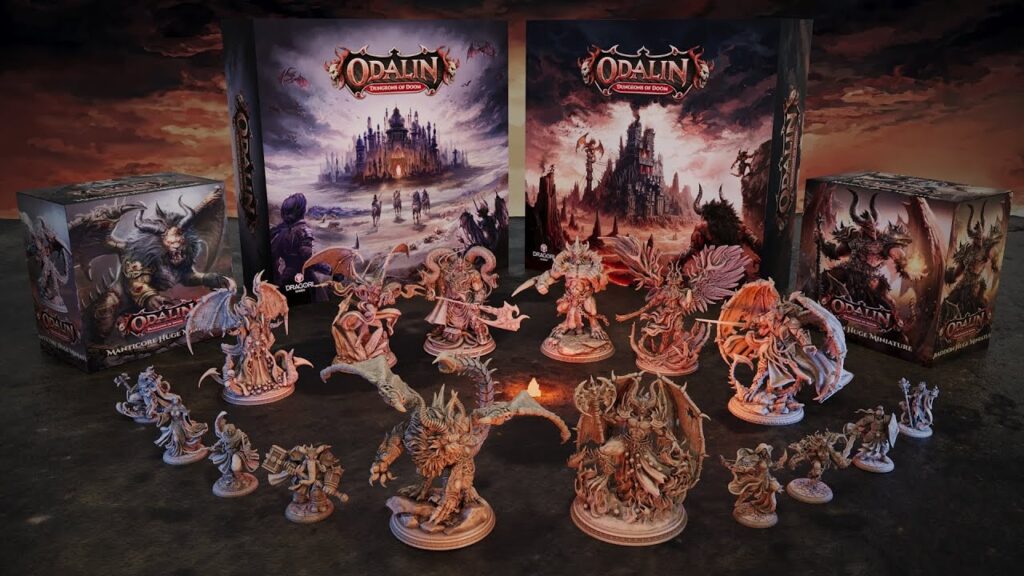
Setup is relatively complex, with quite a few tokens, cards, and miniatures to pull out for each dungeon room. I’ve played games with worse setup times, but I’ve also played ones with better. Odalin reminds me a little bit of Chronicles of Drunagor, with long setup times for battles that are relatively simple.
Gameplay
Odalin is a dungeon crawler, through and through. There is no overworld map, just the narrative to string the chapters together. Almost all time is spent in the massive dungeons, going room to room and fighting enemies in tactical skirmishes.
Heroes and Demons
Assuming the role of one of eight heroes, players take unique abilities, starting weapons and statistics, and a deck of twelve ability cards to start their adventure. Right out of the gate, players are presented with another choice, which demon to meld their hero with.
There are five demons players can choose from, each with different abilities that specialize in a different role. Once chosen, players take the demon cards and attach them to their hero cards before sliding both into specially provided sleeves. This produces a set of unique top and bottom abilities, very much like Gloomhaven.
Additionally, players will occasionally transform into these demons, whether by choice, or if the demon takes over. If by choice, the players can use unique demon abilities in battle for a limited time, but if the demon takes over, the hero becomes an enemy that the group needs to tackle.
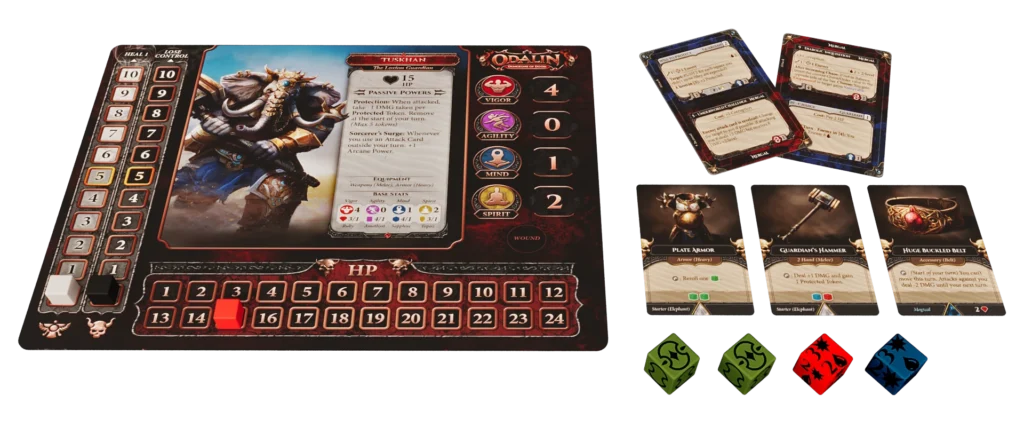
Finally, players have statistics. These are marked by indentations around their characters boards where numbered tokens slot in, providing bonuses for everything from damage, defense, or hp, to the ability to flip some of their cards to their enhanced, more powerful side.
Dungeons and Narrative
Similar to other dungeon crawlers, Odalin plays on dungeon tiles. Each room has one to many doors to other areas, with most of them initiating combat. It’s a bit of a throwback to Warhammer Quest, just without the randomization. There are about 5 or so rooms before players rest at a Sanctuary, where they reset, and level up. Room contents are dictated by the campaign book – describing enemy setup, interactable objects, and any special rules that room has. Each chapter has five sanctuaries, then a boss encounter.
Of note, there is a randomization mode, but it’s quite basic. Called Hell Rifts, some sanctuaries provide the opportunity to enter another plane of existence and battle a random set of enemies in a randomly drawn room. Each cleared room provides a small amount of equipment, so it’s another way to chew through the large equipment decks to search for the juiciest parts of it.
On the narrative side, while each room has an introductory paragraph and then interactable objects to discover later, it’s all fairly light and straightforward. To open each chapter, players read and progress through a much larger narrative story, complete with choices, skill tests, and rewards or punishments sprinkled throughout. It’s reminiscent of Oathsworn or Dante, and the writing in Odalin is definitely good enough to keep players engaged.
Villains
While there aren’t a lot of enemies in Odalin, some even being reused for upgraded versions in later chapters, they are unique. Each has its own deck of cards dictating everything from AI behavior, to unique abilities and attacks. These are done well enough that there’s clear distinction between them, with snake men poisoning, bandit archers delivering sniper shots, and sorcerers buffing, pushing, or pulling heroes around the map. Furthermore, enemies are distinguished by different colored and shaped bases. This prevents an enemy from being #1, #5, #12 etc. which is a common issue with some dungeon crawlers. It’s a neat idea that’s a nice quality of life feature.
Combat
There’s quite a bit that goes into Odalin’s combat. Players draw four cards from their deck of twelve, then use them, or standard actions available to everyone, to perform three actions per turn. One big caveat: players can only play one attack card per turn. This limits the amount of burst a player can output regardless of how their deck is constructed, forcing them to round out their decks with utility. Examples of such are auras that buff the hero and stay on the board, temporary buffs, healing, or instant cards. Instants are interesting. They are out of turn actions that players can perform at any time other than their own turn. While these are largely buffs or curses, they can also be decent amounts of damage, so saving a card for its instant action can be preferable.
When attacking, there’s a few things to consider. First is the dice pool, where players roll all colored attack die from all the items they have equipped. Attacks need to breach defense, so the die results plus card modifiers need “hits” equal to, or greater than the enemy’s defense. If these hits exceed the defense values by three or more, then the attack is a critical hit, allowing players to add critical hit damage from their luck stat. The rest of the damage comes from results on the die, the attack power of the card, extra damage from the strength stat, and any special modifiers like flanking. All of it is added together for a final total, then subtracted from the enemy’s hp. If all this sounds like a lot, it is, but it flows surprisingly well after a bit of practice.
Itemization and Progression
After each combat encounter, equipment and consumables are dished out in measured amounts, usually two or three of each. Players can then swap their gear and update their statistics before continuing on. At each sanctuary, players level up and take one new card of their level from their character’s bank, or any prior cards from previous levels. They can then swap in that new card by replacing an old one.
Of note is that there are legendary and set items in the equipment decks. Borrowing from Diablo, these provide much greater utility than regular items, are rare, and can make a big impact on playstyles. Examples might be adding a dash ability, extra healing, buffs, and more. I found some combos particularly interesting, like focusing heavily on luck and certain damage dice to force big critical hits over smaller, normal hits.
What I Like
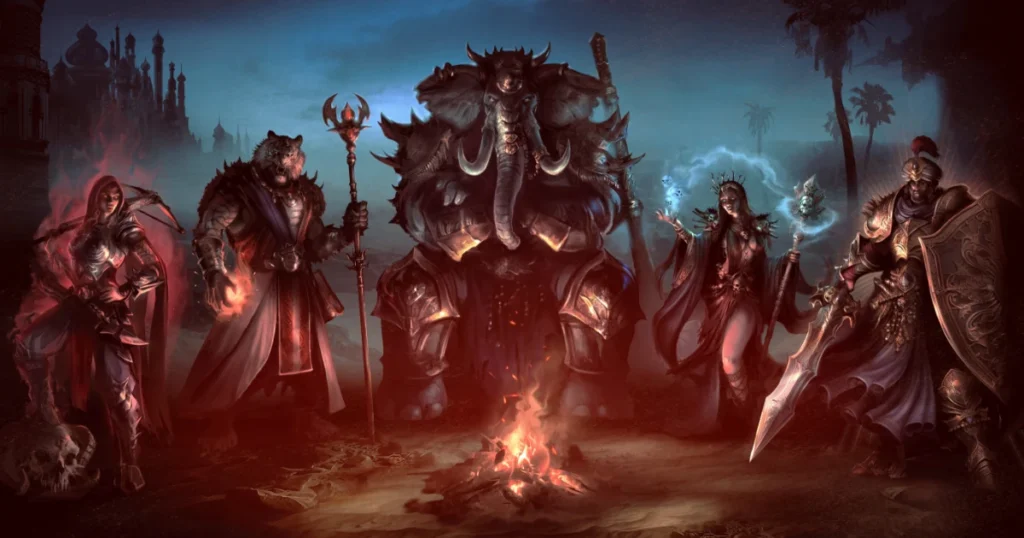
Odalin has many great concepts to its design. It hooks off of other games in the genre like Gloomhaven, Oathsworn, and Warhammer Quest, yet still stands on its own. It does a genius job at streamlining, adding, and concentrating dungeon crawl concepts into something unique.
Customization and Progression
Starting with a big bright highlight, Odalin’s systems unfold in a really satisfying way. Beginning with the choice of demon to merge with, players get to take an already specialized hero and pull it in further directions. This could create a pure glass cannon damage dealer, healer or defender, or a mix of both. This option isn’t locked in stone either. Players can freely switch to any unused demon at any sanctuary simply by changing the demon cards attached to their hero cards. I found myself routinely swapping demons to maximize utility with how my heroes were evolving.
From there, new equipment and consumables sprinkled like congratulatory confetti keeps the loot flowing and the options wide. While most gear is simple and won’t break the mental bank, some unique and set pieces are pretty transformational. I found some items had a pretty big impact on playstyle, especially ones that boosted the statistics allowing for upgraded cards. There doesn’t seem to be a wrong way to play, either, which is great, just more options to push in whatever direction players want to take their heroes in.
Transformative progression takes a while to achieve, but over the course of a chapter, my heroes walked away feeling much more powerful than they did going in. This progression is just about right for the campaign’s length, and it’s one aspect that Odalin nails.
Combat
After getting over the learning curve, Odalin’s combat started to click pretty quickly. It’s clear that the designer was going for a strong tactical experience, requiring a lot of thinking to go into everything from which attack to use, to how to position your hero.
I really enjoyed getting into the turn by turn grit of combat – jumping around the field, dropping area of effect attacks, and managing HP and corruption so as to not tip over into certain doom. There’s quite a bit to do between single attacks, out of turn instants, character abilities, and HP/corruption management.
The overall balance felt about right, though there are certainly some items, abilities, and enemies that are far better than others. In addition, the game offers several difficulty modes. Going easier means less corruption during play, and going harder adds elite buffs to regular enemies, usually doubling their hp. There are tools for players to balance the game how they’d like, and I like that.
Narrative
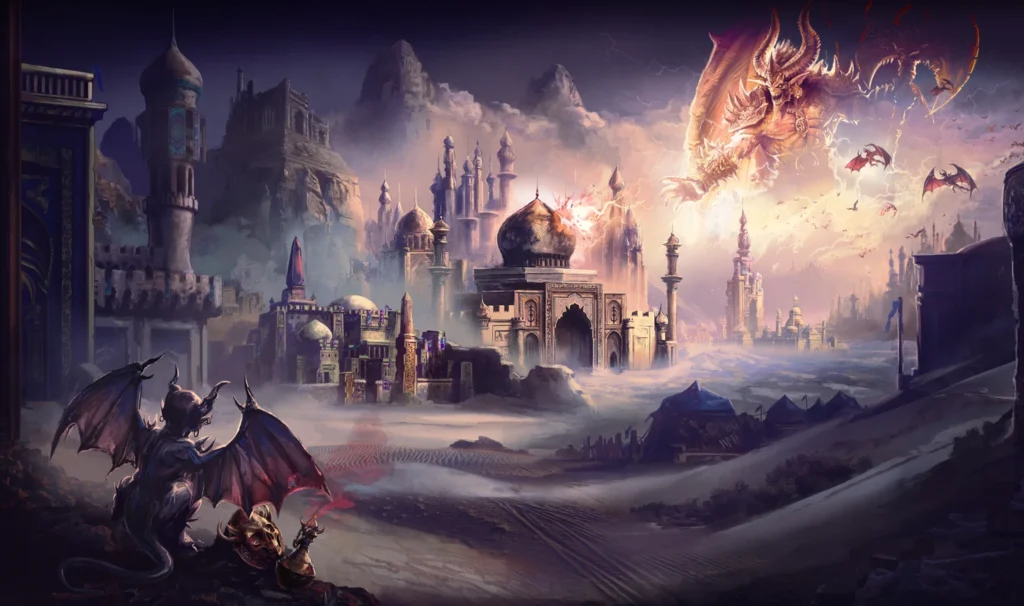
I enjoyed Odalin’s overall narrative. Taking place in a Diablo’esque fantasy Egyptian themed world, it stands apart from the standard European swords and sorcery. The writing is well done, sets the stage for the dungeon encounters, and there’s some interesting immersive qualities to it.
Furthermore, I like that the dungeon rooms are defined by the objects within. Tokens are reused for multiple points of interest, and good narrative descriptions go a long way to making everything feel more unique, despite repeated visuals. One pleasant surprise was the inclusion of puzzles. With the solutions provided in the back of the campaign book, players will need to solve riddles, mazes, or other light brain teasers. Some objects will even be collectible for later, standing out as requirements for some of these optional puzzles. It reminds me of a D&D adventure, and I actually wish that there were more of these sprinkled throughout.
Initiative and Enemy Identification
There’s some cool quality of life things in Odalin. Initiative is simple, shuffling one card per enemy model into a deck with hero cards to create the initiative track for each combat. While there’s a tiny bit of manipulation that can happen here, it’s mostly set, so players can plan around it quite well. In addition, enemy stats are all printed on the initiative cards themselves, so there’s no need for separate ones hanging around the table.
What I Don’t Like
It’s unfortunate that with so much to like, there’s a lot of Odalin that feels underbaked. I think much of it needed another pass to tighten it all up,. Quite a few of the mechanics that I hadn’t mentioned as my favorites are because they feel tacked on rather than essential.
Rules
The rules… They are probably the most egregious part of the game. Out of the box, it’s almost unplayable. Many rules are left out, unclear, or just plain wrong. One example is how the attack dice are gathered: The description would have you believe you only use the dice on weapons for attacking, and only the dice on armor for defending. But this is not the case. Weapons can have defensive die and armor offensive die. That has been cleared up in an errata, so while it’s not an absolute deal breaker, it sucks to struggle so much. Yet what can’t be so easily fixed, however, are more errors, spelling mistakes, incorrect, or wrong words used on the cards and other printed material. While I did not find anything game breaking, it was further disappointing to see just how many there are.
In addition, the rules clearly and plainly call out a Quickstart guide that does not exist. No one received it because Dragori said that they never made one. Apparently at the last minute, play testers deemed it not necessary, so it was skipped. Shockingly, and with how bad the rules are, I think I would have greatly appreciated having one to help get the initial setup straight, because that was also unclear. It’s supremely disappointing that a game that supposedly prides itself on quality would release in such a bad state.
Rewards and Card Balance
Odalin’s card abilities are all over the place. Some attacks are extremely weak, dealing just two or four damage while others deal 10+. Some utility is super situational like only when an enemy dies, and others just not very useful at all, like healing two damage when opportunities to heal much more exist. In fact, during my play, I found it far more efficient to not transform into a demon, because each spirit saved beyond the maximum heals one hit point.
In terms of rewards, while I do like the consistent drip of equipment, I don’t feel they’re ever earned. They’re guaranteed, and I never felt like I had to work for something special. There’s no pushing luck or kicking down just one more door for a shot at more loot. Battles are static and predetermined, as are the rewards. Don’t get me wrong, there are definitely hidden items, there’s just not many wow moments. Touching everything and going everywhere means you’ll easily get most of it.
Weak Mechanics
One that comes to mind is where a hero loses control of the demon inside them and becomes an enemy. On paper it’s cool, but in practice it means that a hero is probably never going to lose control. Rather than succumb, they can just run away and heal their corruption by trading it for HP. I don’t want to say that this event never happens, but it’s really rare. If it were reworked somehow, maybe with less ways to heal corruption but the loss of control less punishing, I think it would really shine.
I touched on the Hell Rifts already, but additional battles for barely a sprinkle of loot is not appealing. It feels uninspired and tacked on rather than meaningful because it’s just more of the same. What I’d like to have seen are some unique challenges for guaranteed rewards, like legendary or unique items. These type of challenges do exist in optional rooms across the campaign, but I think they would serve better as the Hell Rifts themselves. As it is, I usually skipped the rifts.
Finally, I’ll touch on skill tests. Sprinkled throughout the game, they work much like D&D: a d20 roll plus a given hero’s stat. But again, the mechanic feels tacked on, and inconsequential. Tests pop up at random, and the rewards are always very basic. It doesn’t make characters feel like they’ve achieved something special, just that something arbitrary happened or didn’t happen.
Repetition
Odalin’s campaign is long, variety is slim. There’s less than ten enemy types in the whole game, and players generally only fight just one or two types for an entire chapter. While there’s some variety to the rooms, and a few special rules sprinkled in, it’s not enough to switch up the monotony. After even just a few rooms, I already felt ready to move on.
I would have much preferred a campaign that was half the length, but twice as interesting. There should be more puzzles and non combat, more interesting characters to encounter, more side areas to challenge me, and more reasons to come back again. I won’t remember there was a sick snake person looking for their friend, but I do remember the unique boss that can raise fallen enemies from the dead, and the resulting powerful item I got from them, or the puzzles that stopped me in my tracks and teased my brain.
Fiddly Gameplay
There are a lot of things to keep track of in Odalin. Between hero statistics, items, conditions, auras, hero specific auras, flanking, and other hero’s instants, it’s easy to forget something. I think quite a lot of it could have been streamlined away with a good round of revision. Flanking for example, while an interesting idea, does almost nothing. Rarely used, careful positioning to avoid damage is far better than running in and risking oneself for a meagre extra point of flank damage.
Conditions are another example. Overall quite weak, fiddly, and uninspired, all conditions work in 2’s. Adding two damage, reducing two damage, taking two damage a turn etc. two is generally small enough to be ignored. The one exception is when they are stacked. Many times the game asks the player to ignore the condition maximum, allowing infinite stacks of a condition. Now this certainly does have an effect that can’t be ignored, but then it immediately becomes fiddly when needing to add up huge stacks of tokens each turn, plus it’s entirely possible to simply run out of tokens at a certain point.
Poor English
Normally I can give a pass for some bad English, but Odalin has it in spades. We aren’t just talking about a hiccup here and there, entire words are wrong, context is wrong, dashes break up words oddly, and don’t get me started on grammatical errors. Throwing the text through a very simple tool like Grammarly would have caught all of this. While I’m no saint myself, it’s pretty outrageous to see this much laziness in such a big, professional production.
Components
Odalin’s components struggle quite a bit. In the initial print run, the game came riddled with errors, missing tokens, and some cards had incorrect art. To Dragori’s credit, they did reprint the bad content and send it out for free, but it really shouldn’t have happened to that level in the first place.
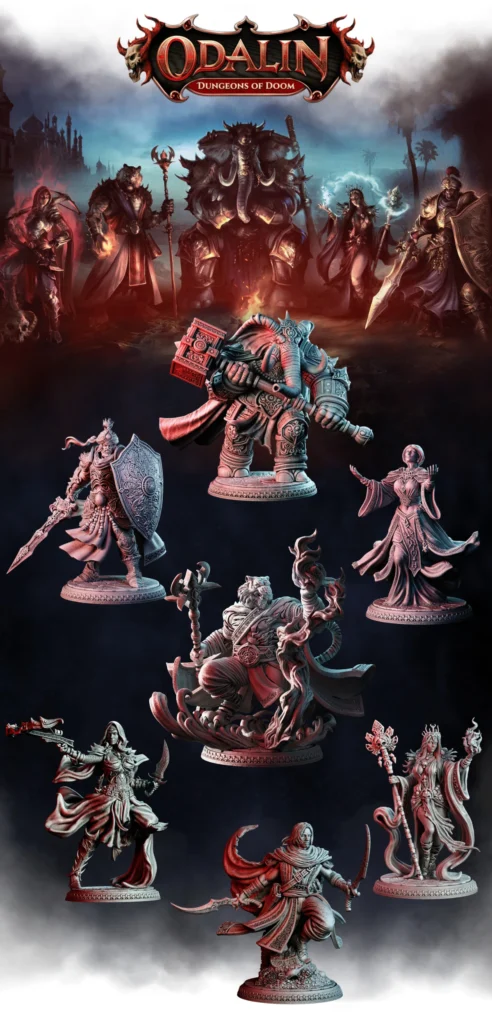
As far as the miniatures go, I don’t think they are the best, neither are they the worst I’ve seen. Some are better than others, but overall the details on them is soft. You can tell it’s there, but it’s very light and would disappear instantly under even a moderately thick paint job. This could be in part due to the fact that they’re made from the same type of hard plastic. While I appreciate that from a durability standpoint, I’m not sure they’re the best for high quality painting.
One of the other problems I have with the miniatures is their bombastic size. Compared to the tiles they sit on, and with tiny bases, their weapons and arms stick out tremendously. When clustered together, everything looks like a big blob, and models will get caught on each other. Folklore: The Affliction has a similar problem. I did not purchase the miniatures for that game and was quite happy to use standees. Besides this, however, the sculpts are interesting, and the poses dynamic, so they’re definitely cool, just maybe less practical.
Finally, cards and cardboard are of good quality and the transparent demon cards sleeved into the player decks are pretty neat. I did not see any warping, tearing, or fraying, and the game box itself is plenty sturdy.
Expansions
For the add-ons, there’s one big expansion, then a few smaller boxes like extra heroes, demons, and bosses.
- Sands of Destruction – This is the first expansion for Odalin. Containing a new adventure with new foes, it does not add new heroes or demons, but offers another long adventure and new bosses to fight.
- Lust, Wraith, Hunger, Darkness – These are new demons for the players to choose from. I can’t comment on how good they are, but for those enjoying Odalin, more options are always good.
- Heroes of War and Magic – New heroes! Each box has four, for eight in total.
- Abaddon and Dragon – Cosmetic upgrades and extra bosses to fight in Odalin and Tanares.
- Special Tiles Pack – These are cosmetic alternatives to the tiles the game uses. To me these are essential, since the dungeon tiles in the game are so boring and reused so much.
- Acrylic tokens, Dice tray etc. – Cosmetic fluff, I skip this stuff, but it’s nice for all-in players.
Voice / Art / Music
Voice
Odalin has a full Foreteller release! 13.5 hours of dialog – whoa! I highly recommend this for group play; no one wants to read 40 minutes of dialog to introduce a chapter.
Art
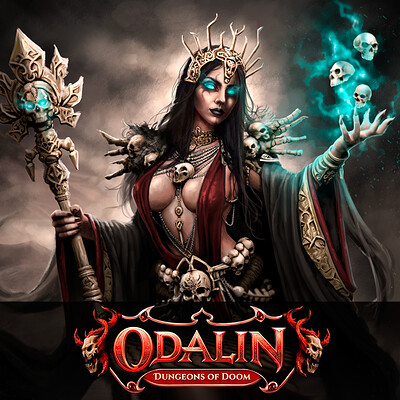
Here’s something I want to dive into a little deeper. I’ll start by saying that generally speaking, I like Odalin’s art. The catch is that it uses AI assistance. Now, AI art has been a pretty big sore spot for a lot of people over the last few years. To Dragori’s credit, they’ve come out and fully admitted they use it in the process (unlike other companies, Hasbro…).
Below is one of their examples of how they use AI to start, then have artists finish the work.
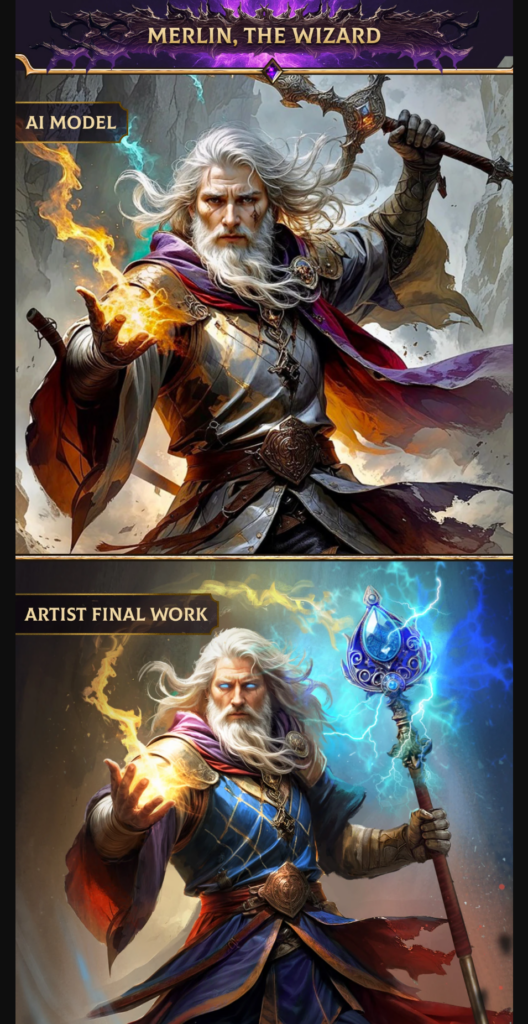
I’ll say this about AI: the technology isn’t going anywhere. Instead of try some kind of hardline boycott, I think it’s alright to embrace AI as a tool. It’s very good at recreating what it’s been taught, but it’s very poor at being creative. This means that for generic art with generic themes in generic games, it’s probably fine. What this really means is that truly unique art from real artists should be valued much higher, and individual styles need to be cherished for the real art pieces that they are. Again, I do like Odalin’s art, but it is on the generic side.
Music
There’s no official soundtrack for Odalin, but any of your favorite dungeon crawl classic soundscapes work. I think Diablo 2’s second act tracks works particularly well here, as Odalin clearly has Diablo inspiration.
The Tales Told
There are spoilers ahead! Summarizing Odalin’s five chapters, I’ll speak a little about the narrative that players can find. This is largely for those that don’t mind spoilers and want to see where the story is going so that they can judge for themselves if it’s worth their time.
I’ll start by saying that I quite liked Odalin’s writing direction. It’s straightforward but immersive, and for a board game, it does the job well. While I was not blown away by anything, and wish that the player’s choices and NPC’s had more depth to them, it’s all serviceable and fun to engage with.
Besides the chapter introductions, room flavor text is simple, usually just describing how angry enemies are lying in wait. It’s the objects in each room that really help define the areas.
Chapter 1
On a mission to defeat Abaddon and the demon hordes, players are guided my a mysterious scroll. Sneaking into a certain ordained temple, they meet Old Hazel, who answers questions and breaks seals to deeper depths. They then find and merge with their chosen demon lords.
After a quick pursuit and escape with Old Hazel, there’s some story around a few survivors, and some of the player’s choices thus far come into focus. After a resistance movement takes shape, players soon discover they have a very serious problem: the demons they merged with are slowly corrupting them. Only Ardvi – the Djinn of healing – can slow the progression.
Unfortunately, Ardvi’s temple lies in a Viper den, and they’re being slowly corrupted by demonic magic. A pact for power went wrong and the once less hostile snake men are now driven mad by the infection that is slowly killing them.
It’s a pretty cool introduction, but I found it long, and a bit confusing. There’s a lot of mystery around why anything is happening, who Hazel is and why the players were chosen to be involved in the first place. Nevertheless, setting up for a dungeon crawl against Viper men is a great start.
Chapter 2
After battling and freeing Ardvi, players discover that they’ll need to free more Djinns in order to control the demons inside them and be strong enough to battle Abaddon. Their next stop is Jakaya, a city holding a temple to the next Djinn, Mithra. After a quick stop for a look at the burgeoning resistance movement that began in the first chapter’s story, players head for the city, which is already under siege and overrun by bandits. There’s a quick conflict over some loot, but players are left with no choice but to enter the besieged temple and fight more of the same thugs and their cultist rivals throughout.
While the story intro is very straightforward and really nothing special, there is much more to be found within the temple. Interactions between corrupted Viperfolk, cultists, and bandits are everywhere. There’s a chance meeting with a Rakshasa, and quite a bit of backstory for some of the characters as well as some of the lore of Odalin.
Chapter 3
Freeing Mithra from corruption in a fairly cool opening scene, players learn they must be onward to the capital without delay. Not far away, it’s a quick jaunt before they sneak into the city through the sewers. Exploring, avoiding patrols, and eventually finding their way into the deeper depths of corruption, they battle with all manner of cultist and demon.
Along the, they discover the captured heads of several prominent noble families. None of these people are without sin, however, and players get to choose how to deal with them, for better or worse. Eventually, they catch up with the king’s counselor, and stories of betrayal, as well as the fate of the noble family members are exchanged. Ending with a fight against the corrupted Djinn of Drought, players move on deeper into the depths of corruption.
Chapter 4
The Djinn turned out to be Trishtrya, Guardian of Water. With few words exchanged, players move on, where they meet a mysterious girl they can take with them into the chapter. Not much more happens in the short introduction, so any more narrative takes place within the dungeon.
Each section continues from the last, where the girl becomes a young woman, then a powerful and experienced wizard. There’s a lot more backstory to the characters revealed, and most of it is pretty interesting. Eventually, they find Queen Seraphine, who is especially important if Prince Jarek is in the party. Players have to fight her regardless, after which her fate is up to them. This leads them to the Djinn of Darkness.
Chapter 5
After making a decision around a regretful, surrendering cultist, players bump into Old Hazel again. Mysterious… but left with little choice, they indulge the old woman’s demands. She helps them push through the final door, and onto the final confrontation with Abaddon himself. Players fight an epic battle, then get their final resolution stories. Finally, with the Djinns freed, they convene with the powerful beings along with Hazel and the resistance. Plans are laid forth, and the story sets up for the expansion, Sands of Destruction.
You Might Like This Game If…
At this point, assuming the update pack is included, I think Odalin is worth picking up for dungeon crawl enthusiasts. If the negatives I mentioned don’t sound that negative, and the positives (tactical dungeon crawling with a steady stream of loot in a very Diablo way) sound incredible, then Odalin may delight. There is a really unique core to the game that I enjoyed, so I’d imagine there will be hardcore gaming fans that feel they need Odalin in their collection.
I would not recommend the game for casual players or groups. Those that don’t like slow turns, lots of setup, narrative, or plenty of time spent on decisions around abilities, loot, and more will have a bad time here.
For gaming groups, if one player took time to learn the rules first and then explain them to the others, plus if Forteller is used to help with the lengthy narratives, I can see the game appealing to some. I’d have no problem letting teens play, as there aren’t themes mature enough to ward them off, but I don’t think this is a game for kids.
Score

It’s quite a shame that Odalin was rushed out of the oven and into our hands. While I’m as eager for my crowdfunded games as the next backer, it really is better to trade patience for quality. While accidents happen, and I can overlook a production error or two, I’m baffled that the game’s components released in the state they’re in. Equally perplexing are play testers that seemingly glossed over gameplay issues and even suggested skipping the Quickstart Guide entirely.
Already in desperate need of a second edition, Odalin is an unpolished gem. There are real glimpses of greatness that shine, however, and I think the game could one day be cemented in dungeon crawl history. Easily jumping in score when the production, miniature, and rule issues are fixed, it could jump again if core systems like demon transformation, conditions, balance, campaign length, and Hell Rifts all got a round of updates. I’ll be a backer of any future editions and expansions since I really want to see where it goes.
Odalin gets a 2/5 without a golden quill.
About the score
Review scores are out of five.
The Golden Quill award is for those games I keep in my collection, though it’s entirely possible for me to rate a game highly but not keep it or vice versa.
1/5: Would not recommend, would not play again
2/5: Some redeeming qualities, might recommend for the right person
3/5: Good game, would recommend
4/5: Great game, recommended that everyone give it a try
5/5: Perfectly achieves what it sets out to do, not to be missed