 Tyson Heckert
Overview
From publisher Dark Gate Games:
Ancient Blood – The Order of Vampire Hunters is a cooperative story-driven game for 1 to 4 players that can be played as solo mode, as standalone games, or as a campaign.
Choose a story and begin your journey.
Be brave and wise, as every choice you make along your path will impact the game world. The wrong choice could awaken your most hidden fears. Fight side by side with your fellow hunters like never before using combo attacks, get help from locals using your skills, find all the clues that will lead you to the master of each Vampires’ clan, The Elder Lord.
Ancient Blood, a narrative forward dungeon crawl board game, was crowdfunded on Gamefound in one dedicated print run, then later in a reprint with a soundtrack add-on on Kickstarter.
In this review I’ll only be looking at the core base game, though I’ll list the plethora of available add-ons and what they bring to the experience.
Player count
Supporting 1 – 4 players, solo players still need to use at least two hunters, and simple mechanics to balance different hunter counts are done well. However, due to the game’s simple and repetitive mechanics, my suggestion would be to play with least two, but preferably three or four players. Lighthearted player interaction pulls a little more enjoyment out of this game.
Play time
Ancient Blood has campaign or single scenario modes, but the campaign is the star experience. Most of the time spent will be in vampire dens, each taking 30-40 minutes to complete, and between these will be story decisions, a town phase, and some light travel events that can add another 30 minutes of narrative ‘glue’.
Gameplay
Ancient Blood could probably most be compared to a mix of Zombicide and a more complex dungeon crawler like Sword and Sorcery. A more tempting comparison might be to CMON’s Bloodborne, but I think Ancient Blood stands further apart from that game.
The main concept of the game is to follow a narrative across towns, random events, and vampire dens (skirmish combat encounters) until eventually finding and defeating an Elder vampire. During den encounters, each room spawns vampires, and most often all vampires in the den need to be defeated to score a victory. Key to combat is close comparison between a hunter’s attack and a vampire’s statistics. If their attack is too slow, it has no hope of hitting the enemy, if its too weak, it has no hope of punching through their tough defense. Dice rolls add variety to this, and ingesting vampire blood to activate attack boosts push this further.
Between the den encounters, narrative story has players stopping at towns, represented by a series of cards or stacks of cards. Each location can have something to do or items to buy or sell, but may also have a small narrative entry on its own, leading to immersive story and player choices. Finally, even the travel between town and den can be fraught with danger, as roaming vampires can find the players and force a quick skirmish with them.
Campaign
The core box includes three stories, each one punctuated by defeating an Elder vampire. These form the campaign. Each story has a relatively light branching narrative and guides the players between towns, events, and dens, even including mechanics for replaying a den after failure (or retreat). After each story, hunters grow in strength by gaining a new personal, and combined attack ability. Stories range in length, but might take players 4-6 hours to complete.
Of note is that between encounters, players take on a “path” event. These vary, but the most dangerous of them force an encounter with a mid-strength vampire, one that can seriously damage the hunters before they reach the next den. The rewards from these are slim, but the narrative impact is pretty cool.
Setup
Depending on the type of encounter (town, travel, or den), setup varies. The most complex of which are dens, with large square tiles used to create the map. Doors connect rooms in various ways, and a few obstacles litter the rooms for cover and a bit of loot. Set up time is quite minimal, normally taking 5-10 minutes at most.
Rounds, Day / Night
Initiative is fairly straightforward with players activating hunters in any order and all vampires activating after each hunter, which can snowball quickly when lots of vampires are around. The only variation to this is that while hunters activate first during the day, and vampires activate first during the night.
Unique to the game series is a mechanic where vampires sleep during the day and wake at night, when attacked, or when hunters create noise. The best part about this is that they can’t defend themselves while sleeping, so it’s entirely possible to run around one-shotting as many enemies as possible before night hits. Vampires are actually weaker during the day as well, gaining a special ability only at night, so even if they do wake, they’re still slightly easier to deal with.
Combat
Ancient Blood’s combat seems a bit confusing at first, but is actually quite simple. First, a mechanic called MASR means some hunters may not have attacks with enough speed to even hit the vampire. Dice based on the attack and any skills or combination attacks being added by ingesting vampire blood affect this value, but it’s entirely possible the attack stops there. Next, defensive dodge results add to a character’s base value to negate an attack’s speed, then hits. Finally, armor reduces any hits that make it through the dodge result and those are the final damage numbers the character takes. This goes both ways for hunters and vampires.
There are some minor additions to combat, like the fact hunters can hide behind terrain to block attacks from vampires or get trapped by falling debris, but honestly these are so minor and used so infrequently that they’re barely worth mentioning.
Of special note is the Elder vampire battles. They’re slightly different in that the Elder has a separate board with a set of four special attacks with hit points next to them. Damaging the Elder damages those hit points, such that those special attacks can’t be used anymore. It’s a neat mechanic, albeit straightforward enough.
Skills
The skills and combination attacks previously mentioned are Ancient Blood’s way of adding more spice to hunter attacks. Hunters start with two skills cards, and need to arrange them to match symbols showing which part of the skill they want to have active at a time. Later, after completing a story, hunters gain a new skill card and further chain them for greater effect.
What I Like
Ancient Blood tries to skirt an interesting line: simplify the previous game in the series, sprinkle in a few new mechanics, add story, and place an emphasis on the amount of content, add-ons, and of course, crossover to the first game.
Combat
While I think it could have used refining, I like the simple combat system. Colored dice for power progression is now a classic among dungeon crawls, and the dodging, armor, and speed statistics all come together to make sense to the player pretty quickly. The one caveat is that I’m not sure I like the MASR mechanic, that is, that you can’t even attack an enemy unless you meet a minimum speed requirement. This means a player knows when they can’t damage a vampire and can only run, probably making them feel useless for a time.
Day / Night
I find this a neat idea. It’s a bit of a race to slay sleeping vampires before they wake up and become more powerful. While I wish some of the dens took greater advantage of this concept, perhaps weaving it into the objectives, it still adds a bit of flair to the planning the hunters need to do.
Immersive Campaign
The theme and writing of Ancient Blood is what drew me in. I’ll have further comments on it in a later section, so while it’s nothing ground breaking, it’s evocative enough that I was sucked in. I do believe that a more interesting theme for the player can compensate for some gameplay deficiencies. I’ll always find grimdark, horror, and especially unique and creative themes more interesting than generic swords and sorcery.
With Ancient Blood, you can really get the feeling you’re in this unique setting. You want to go to the next den, the next town, and the next narrative break. It’s all the right size too. Where some games have a narrative that puts you to sleep or overwhelms with lore dumps, here the narrative is straightforward and familiar enough, yet still captivating.
Player Synergy
Ancient Blood requires at least two hunters to be present. Core to the game’s combat are Combined Attack cards, combo abilities that require two hunters to use. While coordination with other players isn’t a new concept, this particular focus on combination attacks is pretty unique to Ancient Blood. This gets even better when three and four hunters are present, as combination attacks can then come from all sides and angles as hunters progress through a den. It’s a neat concept that adds to player engagement and another reason I like this game better at higher player counts.
What I Don’t Like
So often the death knell of fun is repetition. With Ancient Blood, the oversimplification of its systems mean that while den encounters are thematic, mechanically they can end up feeling more like a chore. Sometimes a game’s expansions and add-ons save it from problems like this, but unfortunately, not here. The dead simple core system means expansions need to hold back on innovation, lest they start to exclude previous content which all needs to be compatible, even backwards to the previous title in the series.
Lack of Progression
The peak of progression is simply a good weapon and maybe an extra class ability or two, to use with vampire blood. Fresh hunters are tossed a random weapon if they want to take on a den as a single encounter and sent on their way. I suppose it’s good to be easy to set up a single encounter, but the game just doesn’t have exciting mechanics or power progression to look forward to.
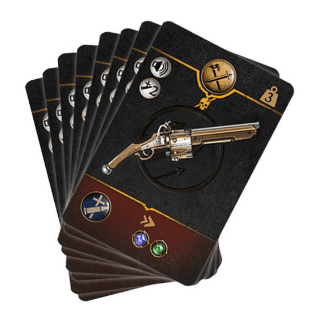
There are no hunter levels and no alternate versions of hunters (besides a corrupted vampire side, but that’s a bad thing, not progression), so there’s no way to ever change core statistics. The powerful weapons players can ‘build’ (practically instantly with how easy money is acquired) have limited ammunition or the chance to break with each use, so they’re used quite sparingly.
Similarly, the enemies never evolve. Dens are not thematically separated in any way. All enemies are spawned at random from a pool, and due to the fact that they’re all similar strength, the ones you first see are the same as the last. Expansions do practically nothing for this, with several vampires being nearly identical, only changing cosmetically or with a very minor difference, often to their nighttime powers.
What this means is that everything game feels ‘stuck’ at the beginning. There isn’t much to look forward to, no new strategies, abilities, mechanics, or anything at all besides the occasional new weapon schematic and a basic class skill upgrade at the end of each story.
Lack of mechanics
Sometimes a lack of numerical progression can be countered by interesting or unique mechanics. Maybe one type of enemy disables a hunter, hides in the shadows, burrows underground, or needs a certain item to defeat. Ancient blood has none of this, and there are no status effects at all. All enemies come in two varieties – fast and hard to hit, or slow and hard to damage. All enemy AI is the same, their attacks are the same, and because of the lack of progression, they all have more or less the same statistics.
Moreover, the den tiles and den scenarios themselves have nothing unique about them. The art on the tiles is generic, and den objectives come in two forms – find the McGuffin, or kill vampires. There’s no race against the clock, survive the endless waves (with one very unique exception in the stretch goals box), escape the dungeon, solve the puzzle, nothing…
Rulebook issues
I also have to point out the terrible rulebook. There is, very thankfully, a 2.0 version available on the publisher’s website. Without it, the game has nigh unplayable parts. What comes in the box is poorly organized, but the biggest problems are the complete omission of several rules and several incorrect statements. It reads more like a beta document, and I have no idea how it passed final inspection.
Components
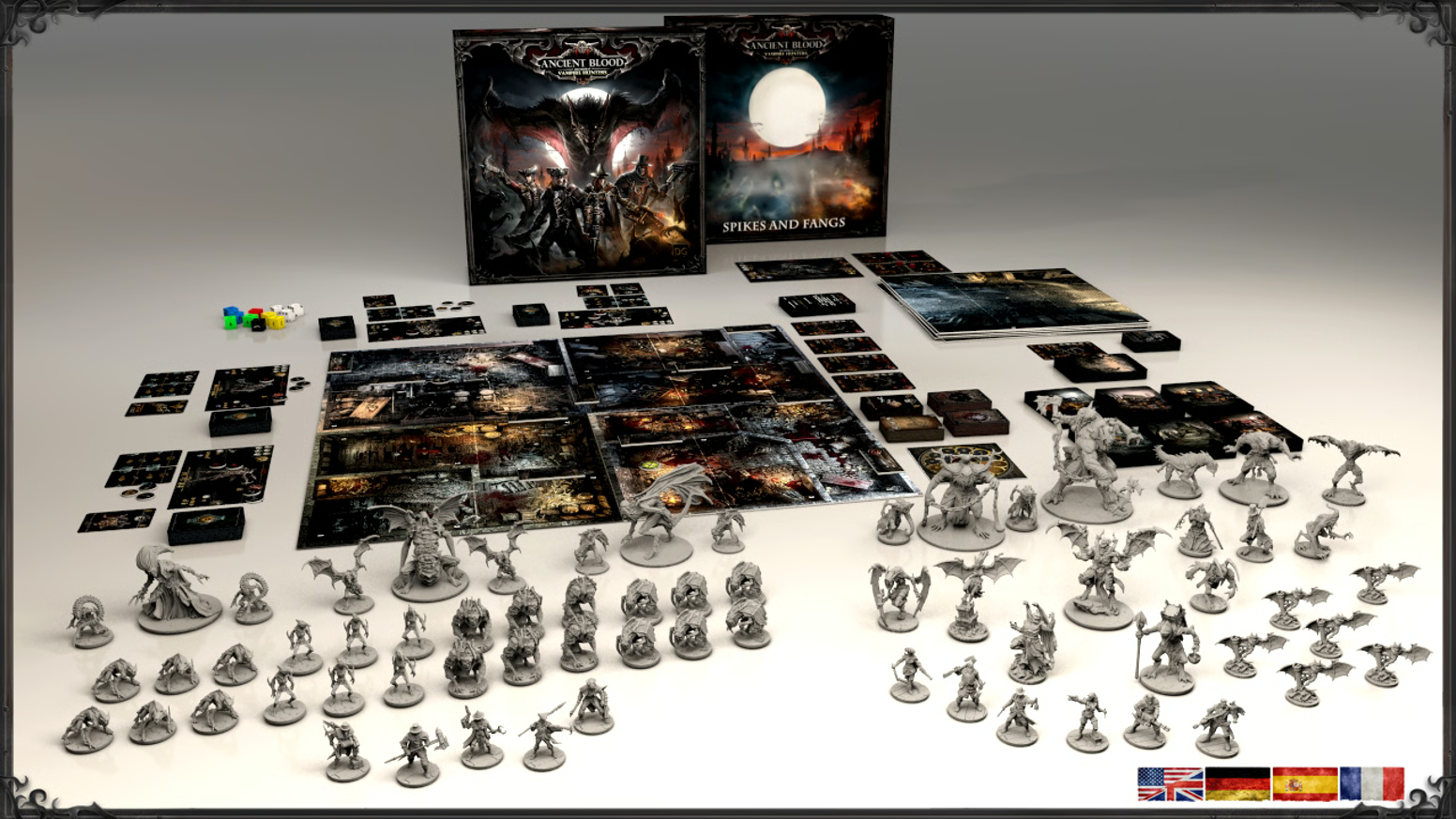
The components of Ancient Blood are great. The cards and cardboard are all of expected quality, with special attention paid to the game’s box. With sturdy construction and art on the interior, it speaks to a premium quality that most other games don’t have.
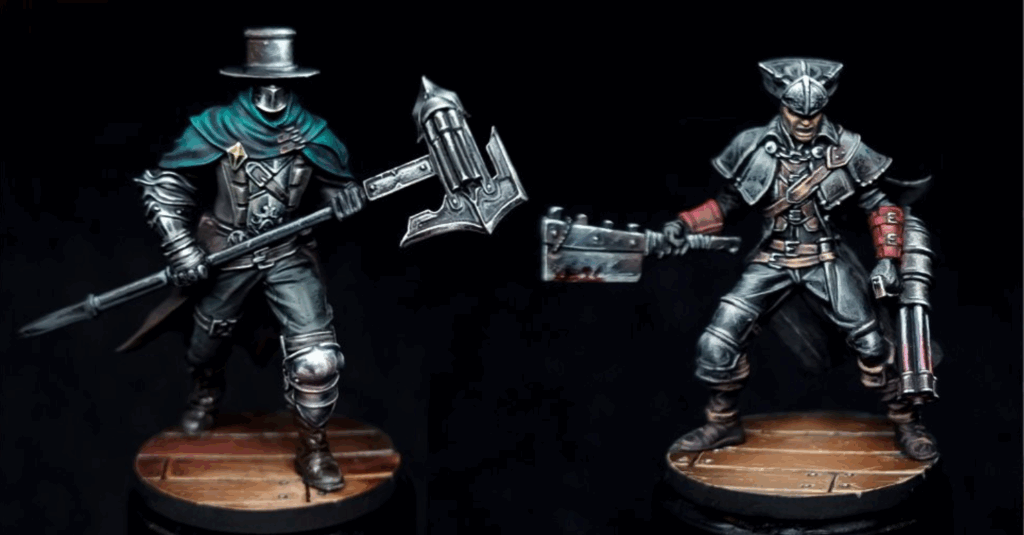
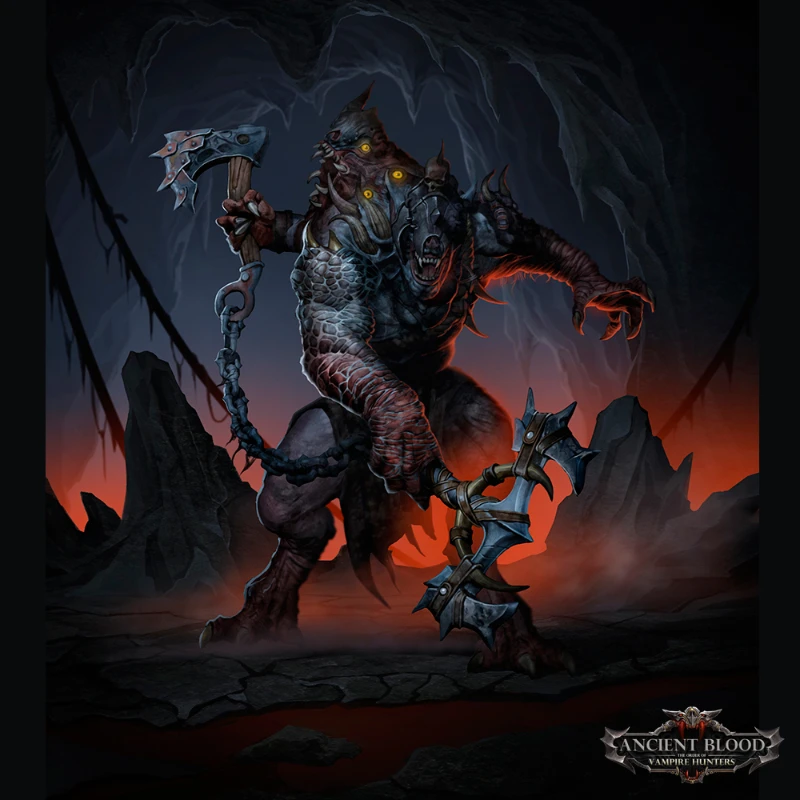
The miniatures are equally good, but their details seem somewhat thin and muted. Compared to DGG’s previous games, or even others in the genre, they’re just OK. The three Elder vampires are all large and unique, the hunters more detailed and interesting, and while most enemies are relatively basic and semi-obscure hunches, or very dog-like, they’re perfectly thematic. All would look great with even a simple drybrush paint job.
Expansions
For the add-ons, there’s a few that make a big difference, and a few that are cosmetic fluff. These are in order of my recommendation.
- Spikes and Fangs: Included with the core box for crowdfund backers. New hunters, new enemies, a new Elder with a new story, new cards for items, paths, abilities, and combined attacks and a number of cosmetic upgrades. I would consider this a must-have simply because it significantly boosts the content (if not variety).
- The Order of Vampire Hunters Upgrade Pack: If you have the previous game, I’d consider this essential. Mixing and matching hunters, vampires, and Elders from both games adds considerable replay value.
- Unholy Cloister: Boasting two stories, four hunters, an Elder, new town, path, and item cards, and new tiles representing the dreaded cloister. While it doesn’t do anything special, I think it would be a great addition if you’re simply wanting more Ancient Blood.
- Wallachian & Khirnanian Clan: These similar, smaller expansions each add a new Elder, story, minions, and path cards to explore.
- Lord Vlad: Much like the above, but Lord Vlad and his giant bat mount is the new Elder this time. It also adds new town locations, new tiles, path cards, and relic cards. Awesome if you want more Ancient Blood. This is thematically the end of all the stories as well.
- The Barkugus: A simple expansion that adds new creatures to fight during path encounters.
- Followers Weapons: Since weapons are some of the only variety in the game, I do consider this a nice expansion, even though it probably should have been part of the core game.
- 3D Tokens & Marble Die: Purely cosmetic, I wouldn’t consider these worth the price, but I know some players like full immersion. The components are good quality at least.
Voice / Art / Music
Voice
While a prime candidate for voice narration, sadly, none exist. The English translation from the writer’s native tongue is a little rough, but the emotional impact is still there. Readers, do your best to punch that emotion up and invoke the dread of Ancient Blood’s world in your players hearts.
Art
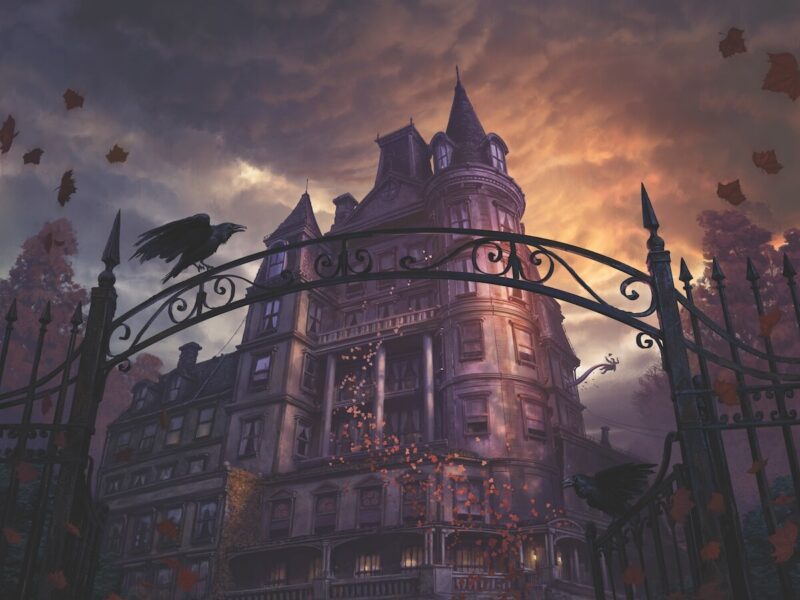
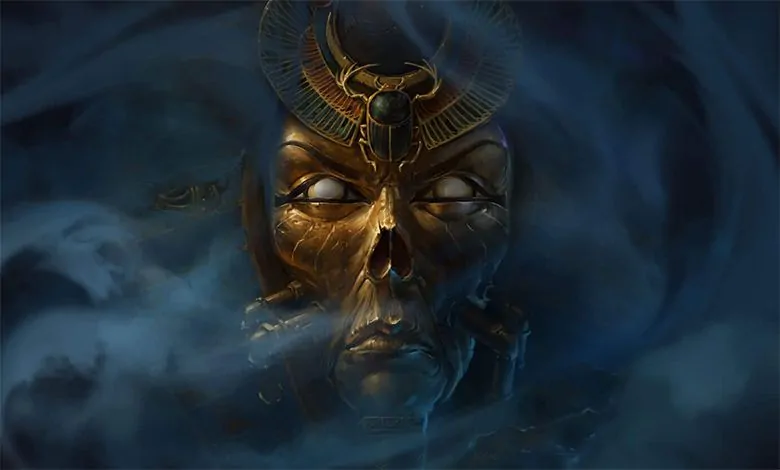
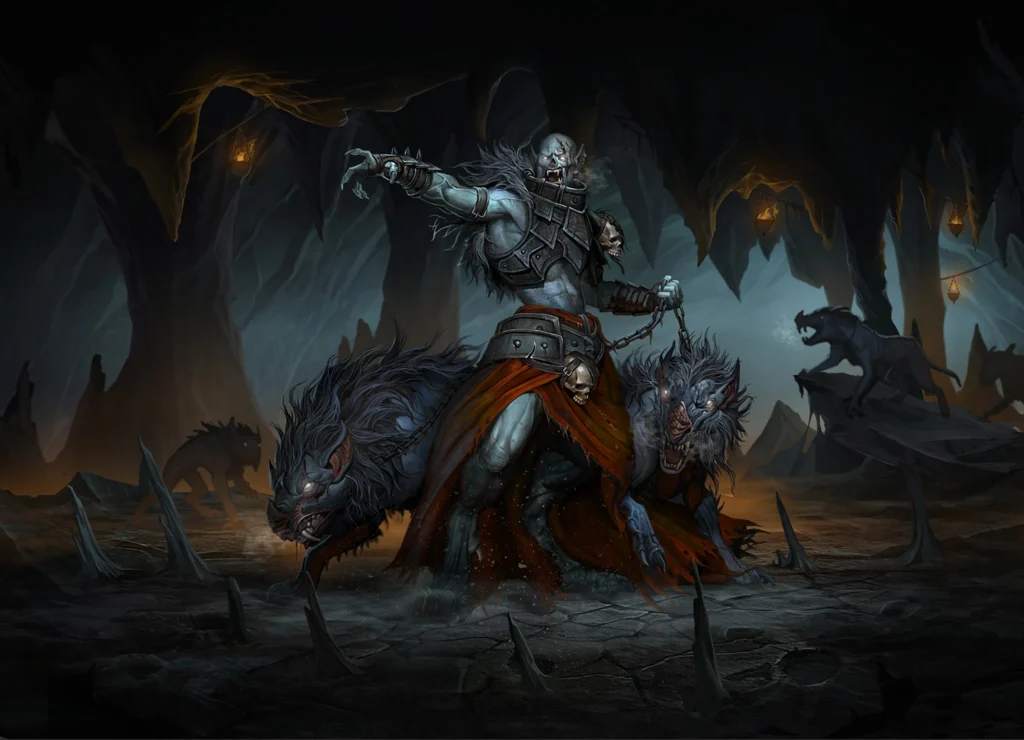
Ancient Blood’s art may be it’s greatest triumph, perhaps even the main draw for many people. Filippo Chirico is credited as the art director. Each piece stays true to the unique, grimdark setting, yet is easy to read and evocative of the game’s theme. The standout aspect to me is the use of color. Background greens, reds and yellows perfectly mix with foreground blues and white highlights.
Music
Soundtracks are awesome, but board game soundtracks especially so. Going the extra mile to maximize immersion is an undervalued quality. Because of this, I backed the soundtrack Kickstarter even though I’d already backed the main game on Gamefound.
The result? Pretty awesome! Created by Androc Studio, this ten track set isn’t going to blow your socks off or compete with Jeremy Soule, but it completely achieves its goal of dragging you into a vampire hunting evening. They were kind enough to upload the final tracks to YouTube, but they’re also available on Spotify:
The Tales Told
Minor spoilers ahead, but I’ll speak briefly about the three stories in the core box, then the one in the Spikes and Fangs (stretch goals) box. Again while the English on them is quite rough, the thematic immersion is definitely there, and I think that’s what counts.
As an aside, I would not say that the emerging narrative of Ancient Blood is very good. There’s definitely some, told through events in town and on the road, but none in the dens. This game squarely focuses on scripted narrative, for better or worse.
Cold
The mission? Slay the Elder vampire. But while it remains encased in impenetrable protection, it isn’t possible. Legend says that the Umareti monks created a map showing the secret locations of separate pieces of a device strong enough to bring down this defense. It up to the hunters to travel the icy lands while stopping by the small, struggling villages still withstanding the vampires. Do battle in dens, and keep a watchful eye on the paths for ambushes.
Light branching adds a little variety to this journey, but the outcome is always the same. I enjoyed the well written descriptions of the towns, and a couple of events unfolded through skill checks instead of den encounters. It’s a light enough story that you don’t need to think too hard, but it’s a good fit for the first few hours of hunting.
The Plague
Kurkistan is beset by a terrible plague. No one knows how it started, but everyone knows they can’t let it spread. Armies stand in the way of helpless migrants and desperate survivors, turning Kurkistan into a giant quarantine zone. Now the vampire nesting in the land can take its pick of those trapped. Its up to the hunters, the only souls brave enough to enter past the blockade, to stop it.
Once again the branching is light, but the theme strong. I felt the despair gripping the region, barely anywhere was safe, and the rest stops were small. I do wish there would have been more to do and see involving the plague, since it was the main narrative string, but I definitely felt distinct separation between this story and the last, despite the mechanics being nearly identical.
The Fortress City
Similar to Cold, here, another Elder has set up in the area and is terrorizing the populace. They are also encased in an impenetrable fortress, and certain precious materials need to be brought together to form a chemical reaction strong enough to break the seal so the hunters can combat the beast.
First, I just love the introductory story. It has flair, like sipping the herbal liquor Taku, or hearing the crunching of the gears as they open the gate to the massive fortress city. It’s another reminder of how hard Ancient Blood’s writing tries to immerse the reader.
However, the main narrative is quite straight forward. Taking on nests and visiting small villages, there’s not much in the way of choice or story branching, and the the creative flair takes a comfortable back seat as hunters go around collecting more material to unseal the Elder.
Much like the previous story, I wish this one utilized the main location much more. The Fortress City seemed interesting, and it would have been fun to chase vampires through sewers or into abandoned furnace factories, but instead, hunters are left scouring desolate countryside. While not adding much, The Fortress City continues Ancient Blood’s established template perfectly fine.
Milleterre
Enter the legendary city continent and deal with an Elder that has taken up residence in one of the districts, causing massive disruption with its services, primarily water distribution.
Feeling like a mix between The Plague and The Fortress City, hunters battle across dilapidated districts and through the remains of the once stronger parts of the city.
With a bit more branching and skill checks to break up the narrative, I did like this story the most. I got a great feel for the desolation of the city’s surviving residence, there’s one den with a different objective than just ‘kill everything’, and even the Elder’s den was more interestingly written that some of the others. It’s a shame that Milleterre wasn’t showcased as a prize of the core box, but it’s nice that backers of the game got it one way or another.
You Might Like This Game If…
I imagine that solo players and fans of dungeon crawlers may struggle with Ancient Blood. While its narrative kept me engaged, others may find it’s simply not enough to forgive the game’s lack of depth. There’s definitely space in the genre for the idea Ancient Blood is trying to hit: a combat light crawler with just enough narrative immersion that players feel like they’re in a grim dark power fantasy like Van Helsing. I just don’t think it hit the bullseye.
I recommend this game for group play instead. More hunters mean more enemies, more opportunities for waking them, and more options for hunter synergy and environmental engagement. Have a laugh, chuck some dice, and get lost in the world. Don’t overthink it and focus on the fun.
Score

Ancient Blood’s immersion is a joy, and it’s narrative the focus. Despite the repetition of den encounters, they are still a fun to run up to the epic Elder one encounters, and the stories had me coming back for more. It’s unfortunate about the rulebook and that there isn’t enough depth to give the game staying power, but I still think it’s a great game for group play, or a solo player like me who feels theme and narrative can shine.
Ancient Blood: The Order of Vampire Hunters gets a 3/5 without a golden quill.
About the score
Review scores are out of five.
The Golden Quill award is for those games I keep in my collection, though it’s entirely possible for me to rate a game highly but not keep it or vice versa.
1/5: Would not recommend, would not play again
2/5: Some redeeming qualities, might recommend for the right person
3/5: Good game, would recommend
4/5: Great game, recommended that everyone give it a try
5/5: Perfectly achieves what it sets out to do, not to be missed