 Tyson Heckert
Welcome to my list of top 5 RPG board games! These are some of the best I’ve had the pleasure to play over the last few years. Ever since the board game crowdfunding explosion of the 20 teens, we’ve been spoiled for choice. This list contains some of the best in class for their genre.
RPG Board Games
So what makes a game an RPG? How does it differ than a dungeon crawl or adventure game? Sometimes the lines blur since many games share RPG mechanics, but my definition has a few key elements:
- Must have some kind of overworld
- One to many towns to visit, partake in events, shops, and perform unique activities
- Likely uses pen and paper to track character progress
- Randomness, from dice, event tables, card decks, or other
- Deep character progression and possibly world progression
- Any pre-written narrative should be flexible enough to provide freedom
If that sounds like a tall order, it is. Dungeon crawls typically have straight forward, often campaign level progression following a set story and pre-made characters. Adventure games take place on an overland map, but generally don’t have any dungeon delving, or they abstract it away. They’re focused on completing objectives, often within a time limit. So you see, an RPG board game really does sit somewhere in between and is unique unto itself.
My Top 5
Without further ado, then, here’s my list of top RPG board games:
- #5: Dungeon Degenerates
- #4: Folklore: The Affliction
- #3: Shadows of Brimstone
- #2: League of Dungeoneers
- #1: Dungeon Universalis
If you’ve heard of any of these before, you might also notice that these games are heavy, crunchy, and complex. That’s on purpose. It’s also why this is a top five list and not a top ten, for now. When I’ve gotten time to properly look at more games that can sit comfortably in the genre, I’ll add them.
Finally, a note on this genre. As someone who has Dungeon Mastered D&D campaigns and loves CRPG video games, from Icewind Dale to Pillars of Eternity, I’m thrilled that board games have reached the same level. This in spite of the mediums being different, and the plethora of overhead that comes with physical components. These games are truly ones to hold onto forever.
Honorable Mentions
Many new and exciting games I’d consider for this list are due to be delivered over the next couple years. I have high hopes that at least a couple of them will beat out my current favorites. For now, here’s a few of the games that I also really like but that didn’t make the list.
- Hexplore It: The Forests of Adrimon – Review
- The Elder Scrolls: Betrayal of the Second Era
- Arydia: The Paths We Dare Tread
- Gloomhaven
#5: Dungeon Degenerates (2017)
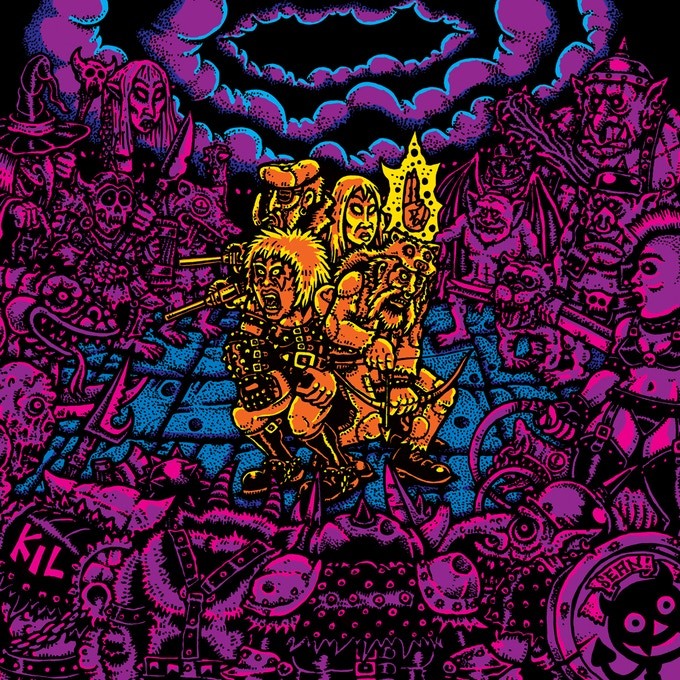
Skirting the line between RPG and adventure game, this game leans RPG for several reasons. The customization, progression, branching adventures, board evolution, large amount of random events, emerging narratives, and ever expanding game world through regular expansions are all exceptional.
While my full review for the game is still pending, let’s take a closer look at why Dungeon Degenerates sits in the #5 spot.
Choices
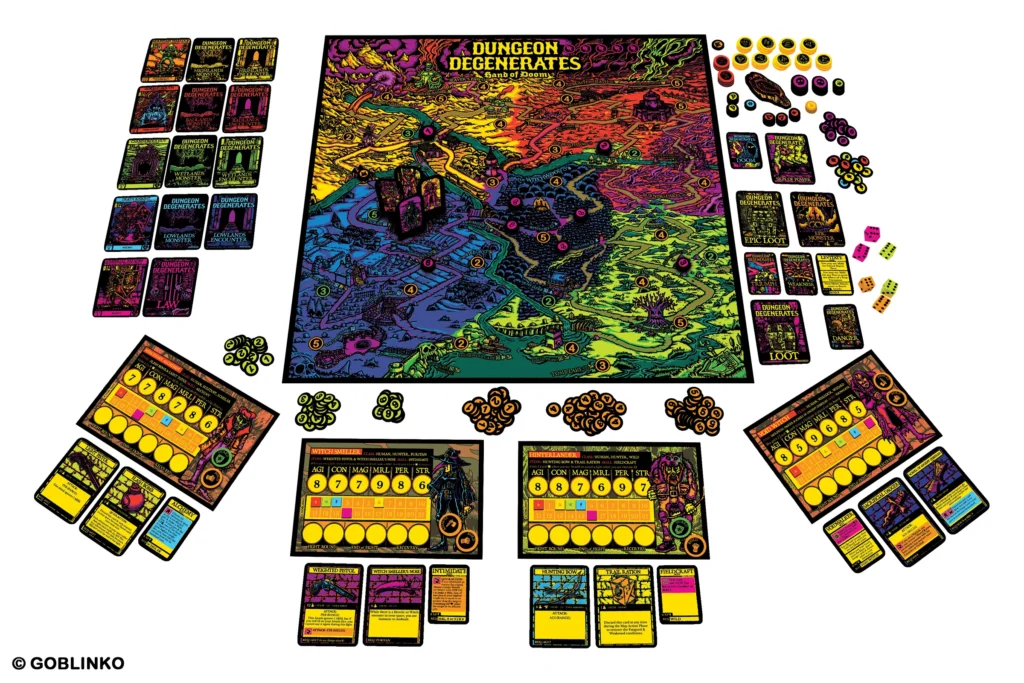
The core box includes eight hilariously interesting degenerates to pick from. My standouts are the Witch Smeller and Bog Conjurer, who are accused of unlicensed witch smelling and uncleanliness & vagrancy, respectively. Currently, expansions add a whopping 28 more characters bringing the total to 36. The newest crowdfunding campaign adds three more expansions with four characters each, for a total of 12 more. That’s 48 characters!
Players are immediately greeted by the whimsically colorful world of the Würstreich, a wasteland where all criminal outlaws are thrown. Their quest branches several times based a choices during the story, so there’s a lot of replayability. Then, the quest itself is open enough that it also grants the freedom to roam the land on side quests, transforming it for good, or evil, to hold back the hand of doom!
Emerging Narrative
The Würstreich is constantly in flux. Colored regions represent unique biomes with towns spread throughout. Each can become friendly by defeating enemies and lowering the area’s “threat”, or hostile if the threat grows too great. Eventually that threat boils over, powering the Hand of Doom, as well as greatly increasing enemy and epic monster presence.
Each biome also has its own unique deck of events and enemies, so wherever you are, it’s oozing with theme. The emerging narrative is extremely strong, so It’s hard not to be fully immersed. The writers took care to flesh out the world to such a high degree that it feels alive.
While the ultimate goal is to follow the main quest and stop the hand of doom, how players get there is up to them. The main narrative follows a familiar gamebook pattern, yet expansions offer so much more to do that it can be tempting to toss it entirely.
RPG Mechanics
Characters have a class, stats, abilities and items. They can choose to be offensive or defensive in battle, and dice determine the outcome of tests and combat results. Progression comes mainly in the form of new ability cards, both passive and active, and new items. This is all very RPG.
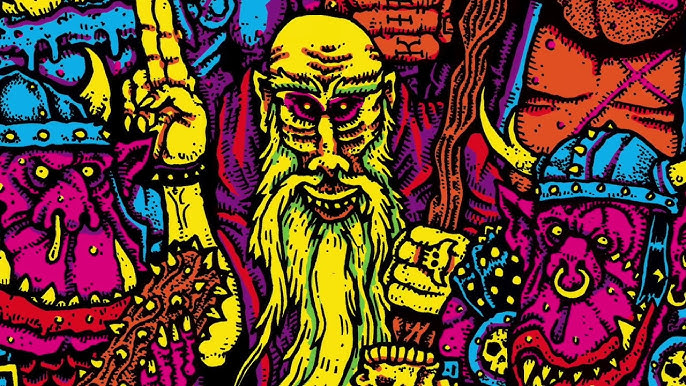
While the game has enough tokens, boards, and trackers that pen and paper isn’t necessary, it never hurts. Especially when “saving” the game for later, I think players will need to write down their character and world states.
Verdict
So why’s it sitting in #5? I absolutely love Dungeon Degenerates, but it doesn’t get quite as deep as the other games in my list. It sticks to the overworld, even when jumping into a completely separate side quest. It also keeps the overall progression light, instead focusing on the evolving narrative of the party, and the Würstreich. Even though it has side quests, random and highly thematic events, bosses to hunt, and plenty of other things to do, it still feels like it sticks to the defined conditions, start and end, win and lose.
Happily, even though the game regularly has crowdfunded printing campaigns, they are not strictly necessary in order to get a copy of the game. Dungeon Degenerates is available now from the publishers website.
#4: Folklore: The Affliction (2017)
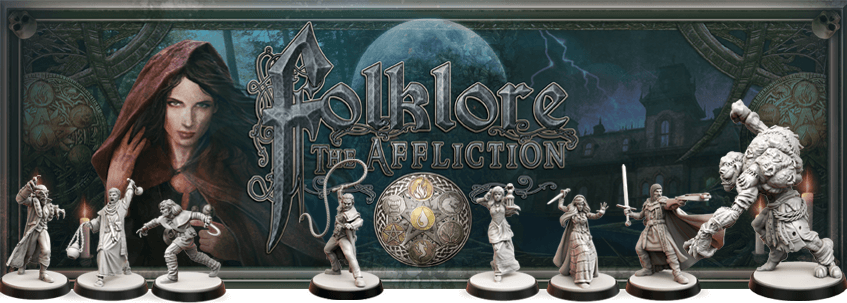
What do you get if you mix D&D with a skirmish board game and theme it like Van Helsing? Folklore: The Affliction of course! While Folklore does have the strictest narrative quests to follow, it’s saved by the expansion, Dark Tales. It introduces Rumors, which are random quests. Rumors can be taken on at any time, or even become the main focus of a completely sandbox, custom experience. While my full review for the game is pending, let’s look at what makes Folklore one to remember.
Character Depth
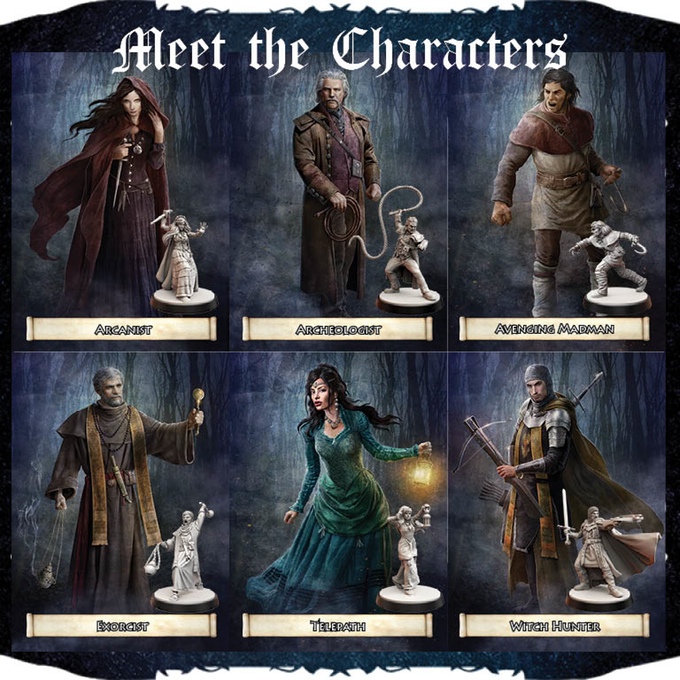
Folklore has a wonderful amount of character options, and plenty of progression. The core box has six archetypes to choose from, and the two expansions have six more each. These aren’t just warrior, wizard, and thief, either. There’s the Witch Hunter, Telepath, Archaeologist, Madman, Exorcist, Arcanist and more. The first choice after that is what subclass to pick, each archetype has two. By picking one, it provides a unique ability, and an upgrade path to follow. While the subclasses don’t wildly alter the playstyle of the character, they do provide enough differences to keep things interesting.
Players will need a pencil and paper as they progress. Official printable sheets are freely available online, and custom community ones provide additional formats for even easier play. My personal favorite is here, allowing a solo player to track three characters at one time on a single sheet. Bookkeeping like this is necessary because over the course of about ten levels of so, statistics, xp, items, abilities, and upgrades change all the time.
Overland Exploration
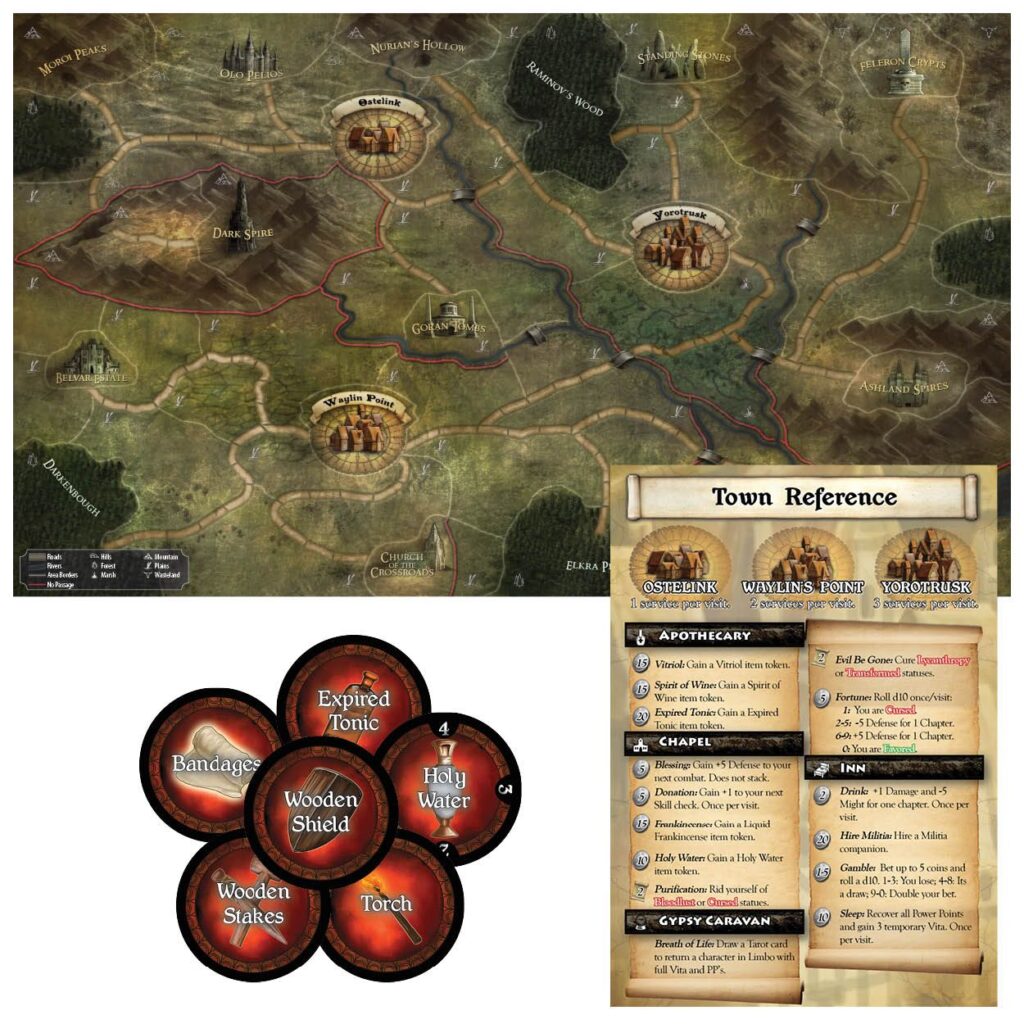
Taking place in the land of Kremel, players will travel been around ten different spaces on the board. Between dungeon delves (called encounters), play is open, so as much travel to other towns, or into dangerous off-road territory for the possibly of some additional loot is possible. Players will want to travel to the local church to heal afflictions or rid themselves of death penalties. Lastly, specific towns will hold specific special events, actions and items for each character. Shopping in Folklore is a joy.
Towns and most interactable areas are connected by roads, and if they’re not, off-road spaces. Stopping on either, and if it’s day or night, makes the players draw an event card. The roads are safer than the off-road areas, and everything is safer in the day.
I love having the map of Kremel on the table. It adds another layer to the immersion and makes traveling feel that much more dangerous, and alive. While some games gloss over travel as with a simple bit of story or with a random event, Folklore makes it just as much a part of the journey.
RPG-like Adventure Mechanics
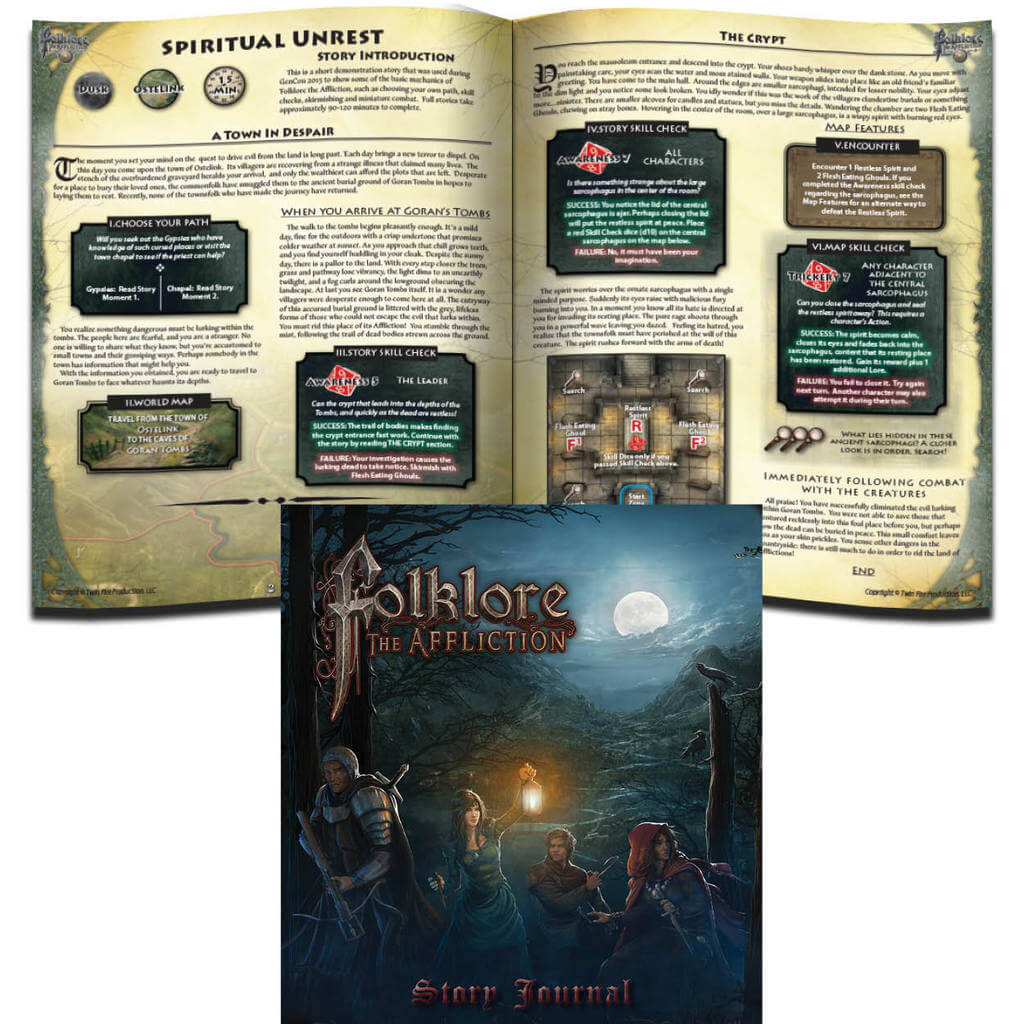
Quests in Folklore share a few similarities with TTRPGs. There’s no DM, but they still take place on large, square map tiles. These will include everything from searchable objects, to special doors, cave-ins, traps and special events. Players will make story choices along the way, earning them special rewards and recording the outcome with colored story markers. These come up later, naturally, so they’re a great but simple reminder that choice matters. The story is light, impactful, and doesn’t overstay its welcome, spanning about three “chapters” per “story”. The campaign book has about seven stories, so it has legs. It’s all very well done, and I think that for a group that likes TTRPG’s but doesn’t want the overhead of a full system, any improv active, or reliance on a DM, it’s a slam dunk.
Expanded RPG/TTRPG Options
One of the more interesting expansions to the game, called the Adventure Creation Kit, is a real stand out. Heralding back to the days of Warhammer Quest and its Roleplay Book, it has a massive amount of information for potential DMs. New ideas, optional rules, content, and tables for all of the cards and enemies in the game are included. This means that, with a little work, Folklore could land as essentially a TTRPG like D&D, but with board game components. While it’s not as complex as most TTRPG’s, that’s not a bad thing, either.
I can’t claim to be one of the people who have tried the ACK, but I love the idea. One thing I have done, however, is tinker with a few house rules for the game. I found it overall a little punishing, so my house rules are quite simple: 1. May rest after every encounter, not just once per chapter. 2. Replace any existing tarot card with the new one when being brought back to life, preventing a deadly snowballing of negative effects.
Verdict
I haven’t talked about the combat in Folklore yet. That’s one of it’s weaknesses, and a big reason why the game sits lower on this list. Using a d100 system to hit, d10s for skill tests, scant ammunition to keep track of and run out during battle, some uninspired and ineffective abilities, and an hp/energy tracking mechanic that is more fiddly than anything, it comes up short. While not broken, and definitely serviceable to keep the game moving, it pales in comparison to real TTRPGs.
Yet with the RPG mechanics being so effective, and lots to see, do and enjoy in the land of Kremel, the game has to make this list. With fantastically written, designed, and executed quest lines, memorable characters, plenty of room for swingy success, or terrible failure, and a wonderfully immersive theme to wrap it all up, Folklore hits my #4 spot.
Sadly, the publisher Greenbrier Games is now defunct. While copies of the game are still floating around some retailers, they’re dwindling. I would assume that in a few years from now only second hand copies will be left.
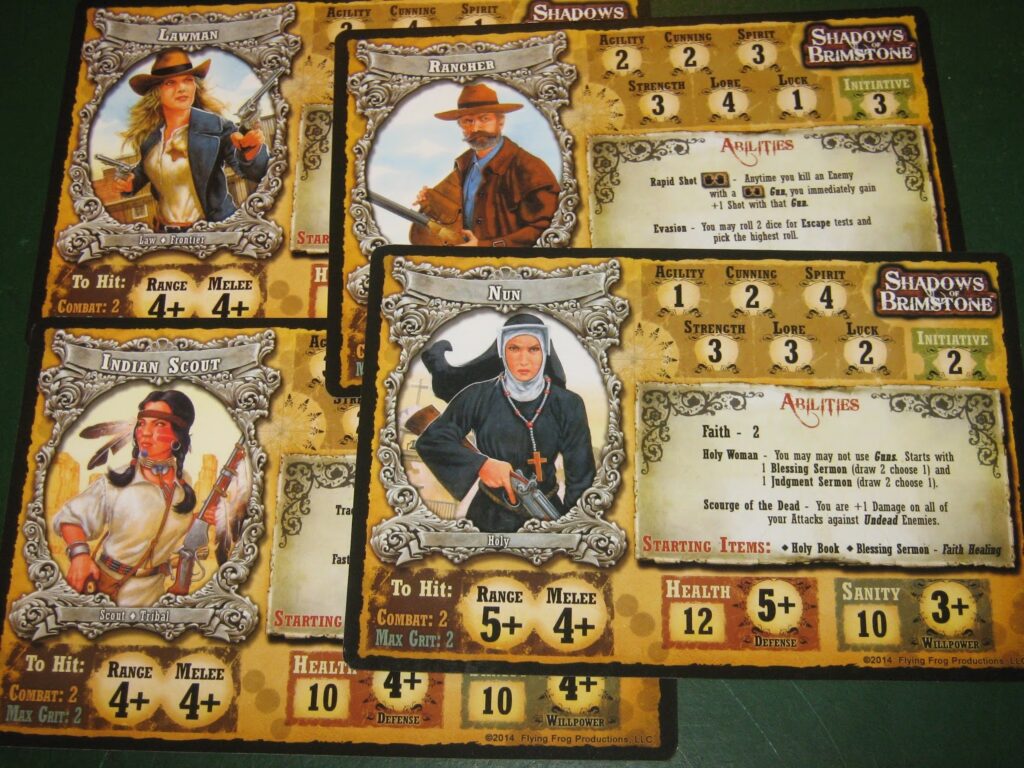
#3: Shadows of Brimstone (2014)
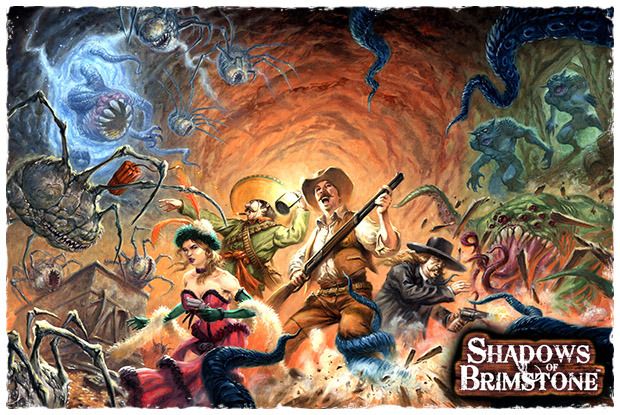
Borrowing from the great Warhammer Quest 1995, Shadows of Brimstone replicates the best of that classic game, then puts its own spin on it to stand on its own two legs. For anyone unfamiliar with the core aspects of classic WHQ, it has a heavy reliance on random events, dungeons, die rolls and of course, deadly situations. I’ll have a full review for the Shadows of Brimstone series at a later time, but spoiler: it’s one of my very few 5/5 perfect score games. This doesn’t mean the game itself is perfect, actually it carries some of the dated mechanics of its predecessor, only that is perfectly achieves it’s vision. It’s a game system that’s endlessly replayable, flexible, expandable, and unlike any other. Lets take a look at a few of the things that make it so.
Never Scripted
One of SoB’s greatest strengths is in the fact it never follows a set narrative, campaign, or even dungeon layout. Well, I shouldn’t say never, because there are loose narrative strings between some quest lines, the campaigns do end eventually even if it just means characters have reached an apex and should retire, and some dungeons do come with a pre-set layout. All of that takes a backseat to the core design, however.
Quests are guides, not concrete structures. With objectives loose to just be: kill enemies, gather something, or reach a certain point, how players get there is the real story. Which rooms, events, enemies, and even whole other worlds they’ll see are all randomly generated from card stacks. While some rooms and events thematically fit together, and players can stick those events to the rooms if the wish, it’s also possible to mix and match such that any room can have any even happen in it. From a water filled slog, to an undead ambush, poison gas or even the hint of treasure, there’s a lot that can happen.
Expandable, Modular
Tying into my previous point, one of the best things about SoB is its expandability. Because what happens comes from a stack of cards, to increase what can happen is as easy as adding more cards. Since Old West mines are the most common biome players will be in, most expansions have mine tiles, events, and items. This means the sheer volume of adventure in just that place can grow to a massive scale. Some players do enjoy mashing all expansions together into a mega game, but I actually recommend thematically curating the decks to fit something that players find interesting.
Want to take a band of adventurers hunting for monster parts? Pick up A Study in Terror, a small card expansion in which your Medical or Science characters go on a side quest for just the right ghoulish monster pieces. Or maybe this time the mines has werewolves and a set of otherworld travellers like the Flesh Stalker. Or maybe you’re up against cultists who (flavor) are responsible for some of the dark creatures lurking in the shadows.
Character Progression
While SoB’s progression is not wholly unique to other games on this list, in fact it’s quite similar to Folklore, it sits firmly in the RPG category. Characters start out fairly weak and relatively straightforward, but as they grow in strength, they become quite powerful. Many perks gained can radically change their power, and new items found along the way make them a force to be reckoned with. There’s a little restriction, but not much, so most characters can use whatever they find, even alien artifacts. There’s real transformation throughout their journey, and many, greater challenges in further expansions.
Verdict
Taking a top spot on my list, Shadows of Brimstone fits a unique bill. And one of the best things about it is that it is not rare in the slightest. With how much of it has been, and continues to be produced, even on crowdfunding, there will always be copies of this game available. That doesn’t mean there isn’t exclusive content, just that the core boxes, and most expansions, will continue to be printed for the foreseeable future.
#2: League of Dungeoneers (2022)
Skirting the line between a full blown TTRPG and board game, League of Dungeoneers does something really different than most. With a massive rulebook and enough systems to rival D&D, yet still offering DMless dungeon crawling, it provides a really unique alternative to traditional games. Read my full review for a more detailed look, but here are some of the reasons this lands in my #2 spot.
Roleplaying Depth
No I don’t mean roleplaying in the improv acting sense, I mean the mechanical embodiment of the character(s) and the decisions made in those character’s shoes.
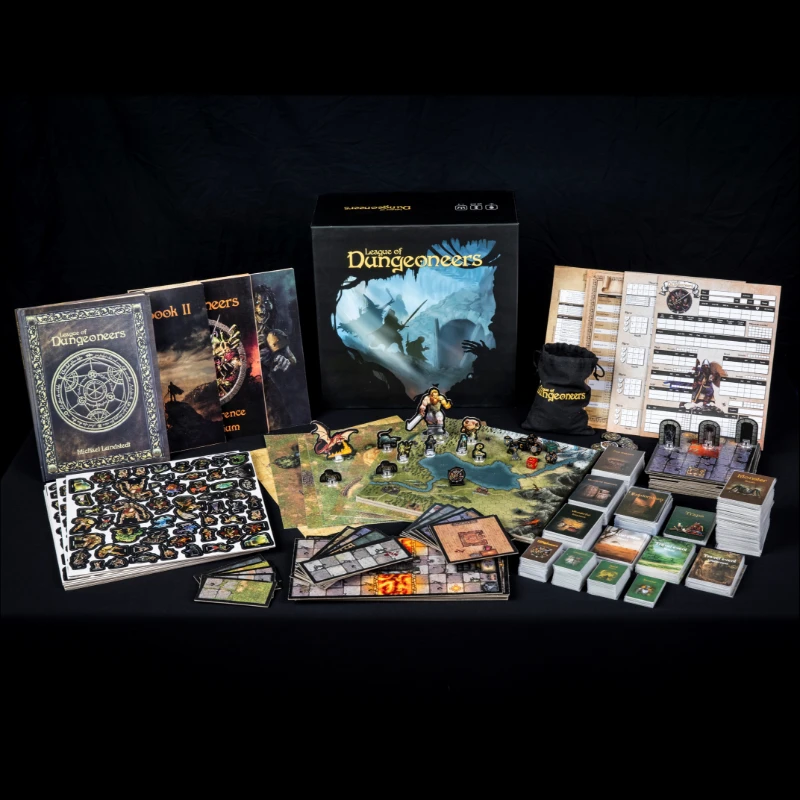
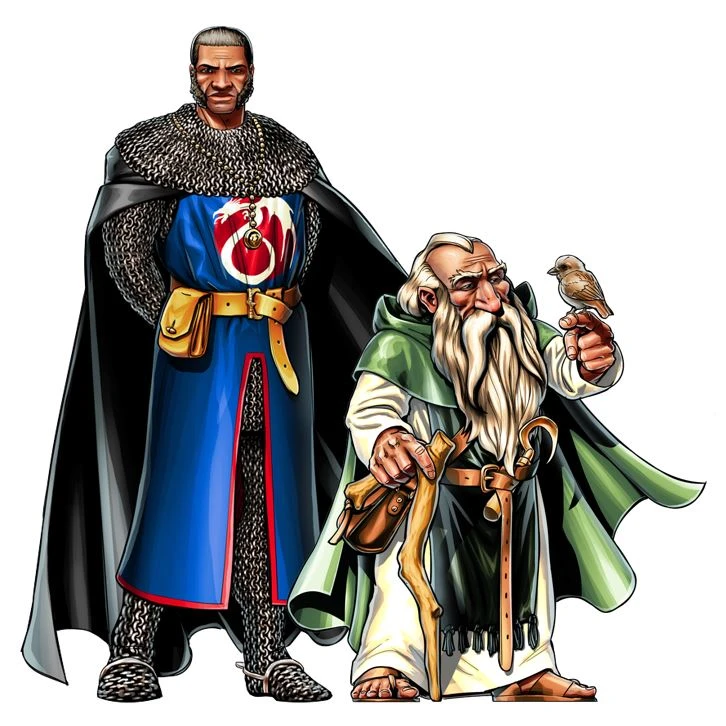
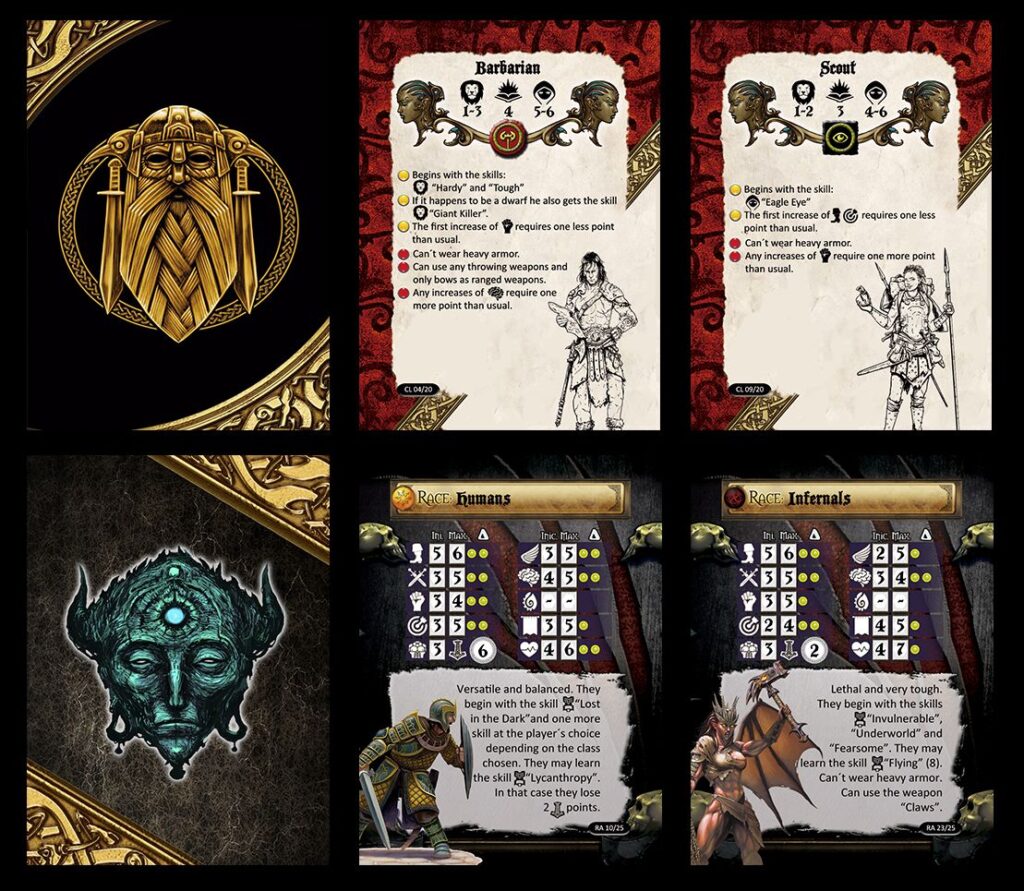
Any good RPG is going to start with character creation. While your average board game is going to provide a choice of pre-made characters, here, players make their own. It’s extremely D&D like, with a similar choices of race, class, stat proficiencies, perks, talents, background, and equipment. There’s also no big plastic board to keep track of a character in League of Dungeoneers. Players get a sheet of paper to fill out, and will need to update it as they go.
What I really like about this system is that it does carry the same weight and progression of its heavier cousins. About the same as OSR games, when characters level up, it’s a big deal. They’ll earn additional HP, Talents and Perks, which give situationally noticeable improvements to their power. Furthermore, itemization is important, and players can find enhanced, magical or legendary items with special abilities. Any fan of OSR is going to know that a simple move from d8 to d10 damage dice, or even a +1, is huge. Finally, and they’re quite rare, but players can find power stones, items that let players create their own magical items!
I almost forgot to mention the robust alchemy system in the game, including a whole alchemist class that focuses on the profession. While it’s a tough one to take full advantage of, it’s oodles of fun to want to look for specific creatures because you want their parts.
There are lots of ways to customize characters, and they’re all fantastic.
Dungeon Crawling Amplified
Borrowing from Warhammer Quest 1995, yet taking the system further than it ever went before, League of Dungeoneers offers dungeon crawling that’s thematic, tense, dangerous, and satisfying. Players will build the dungeon by adding a number of both pre-determined and random room cards from a massive stack of availabilities to an exploration deck. Rooms can have detrimental effects, searchable objects (which usually correspond to art on the tiles), branching paths, and all of them can be generally searched for treasure.
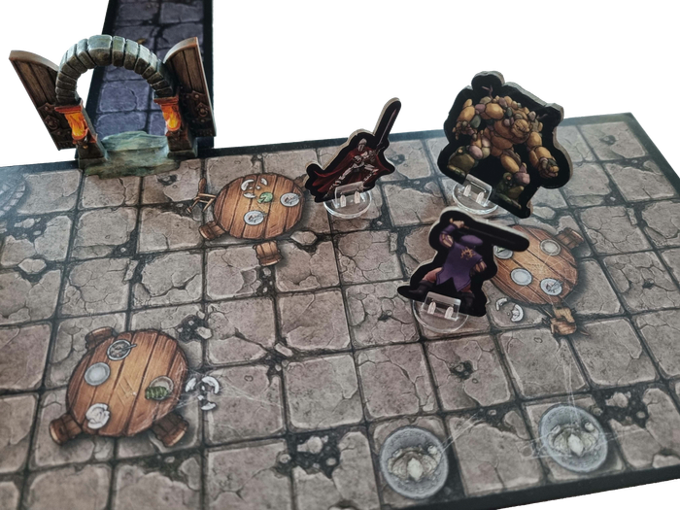
Each door can be trapped and/or locked, causing quite a bit of trouble for the players. Traps can be disarmed, set off on purpose, or accidently triggered, if not detected. Locked doors can be picked, or bashed, and when unlocked, can be closed and barred again. This is essential for the other major mechanic, wandering monsters. Players roll each turn to see if something bad happens. With an incrementally increasing chance for this to happen, something will happen eventually, and it’s usually wandering monsters. These enemies start at the beginning of the dungeon and chase the players around, but players won’t know what is chasing them until they gain line of sight to the group. Closing a door will naturally prevent this, and slow down those enemies, so it’s quite a good idea to close up before you leave.
Besides the normal smash and grab you’d expect from dungeons, there’s always an objective room, which often has something unique to do in it. Sometimes this is a just a boss to kill, but other times there will be a unique challenge to overcome. These systems come together in a wonderful way that is a little hard to wrap your head around at first, but eventually snap together into a tense, unscripted, usually surprising, and always fun way.
Sandbox Adventure
Several campaigns are included among the core rules’ Quest Book I, separate Quest Books II, III and an additional, smaller campaign in the Ancient Lands. That’s already a lot to do. But in addition, each settlement, or more so the Silver City, always have the opportunity for random quests based around one of several objective rooms. These are very much like Warhammer Quest in that regard. In true sandbox fashion, players are free to start and stop any quest or campaign as they like. Those in the Ancient Lands are meant for higher level characters who have completed the first campaign, however. Some campaigns are small, deadly dungeons, while others are more sweeping. And of course, it’s perfectly fine to mix and match as players desire. The sandbox is wide open!
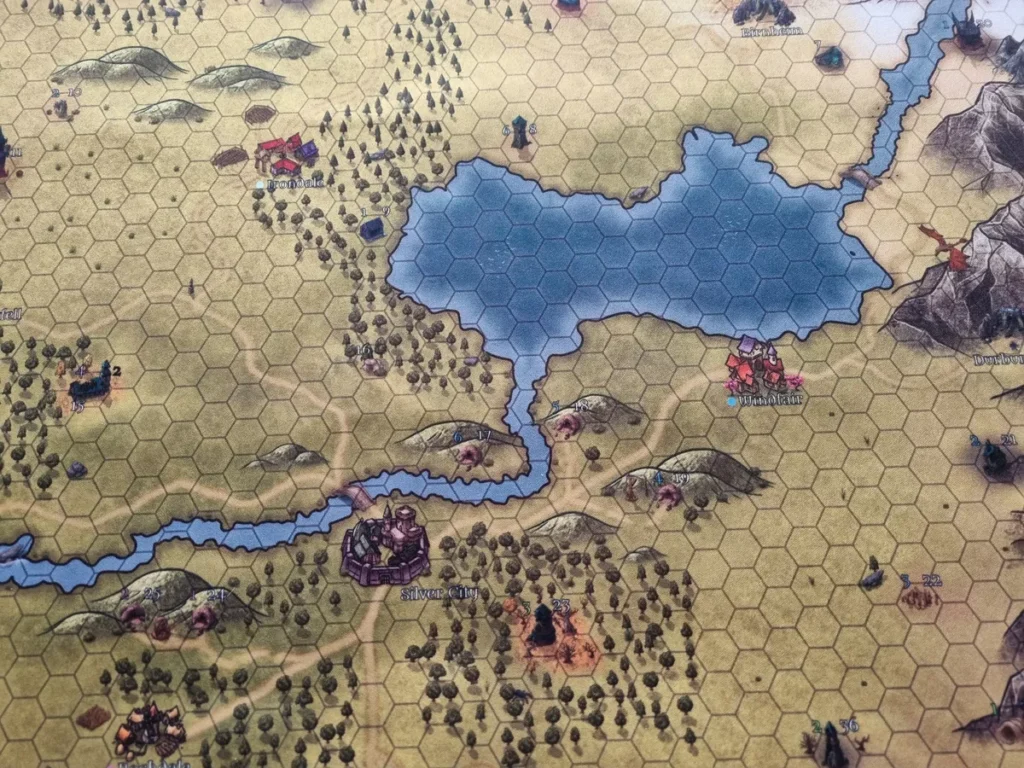
Adding one additional layer of spice, characters can optionally start with a background. This often adds another objective, just for them, and another reason to travel or dungeon crawl in specific ways. Lastly, players can visit the Silver City, with everything from gambling, to special events like arena combat, and specialized guilds to gain everything from new gameplay changes to special items.
DMless RPG
While a real DM can never be replaced, no one wants to forever DM. Having a system so that anyone in the group, or even solo players, can enjoy a game without the overhead of adventure preparation is great. League of Dungeoneers’ dungeon generation system, where random rooms and corridors are strung together and die rolls determine which ones have enemies and loot, is reminiscent of a video game like Diablo. The Threat system determines how often something bad happens, largely affected by the party’s actions, and this takes the place of a DM tossing in encounters to keep the adventure tense. It all comes together in a really nice way to where what happens doesn’t change, but when and how does.
Verdict
So there it is. While the weight of the game’s many rules can initially feel crushing, it’s easy enough to play the game loosely and not worry about missing something from time to time, at least until it all clicks into place many hours later. The combination of random dungeons, character progression, sandbox design, and OSR feel really comes together into something that’s evocative of solo D&D, in the best way possible. There’s no other game that comes close, and that’s why League of Dungeoneers sits in my #2 spot.
As of this writing in 2026, I’m pleased to say that copies of the game are readily available on the Publisher’s website. I do consider it worth the larger asking price, as it’s a game to hang onto and enjoy time and time again for many years to come.
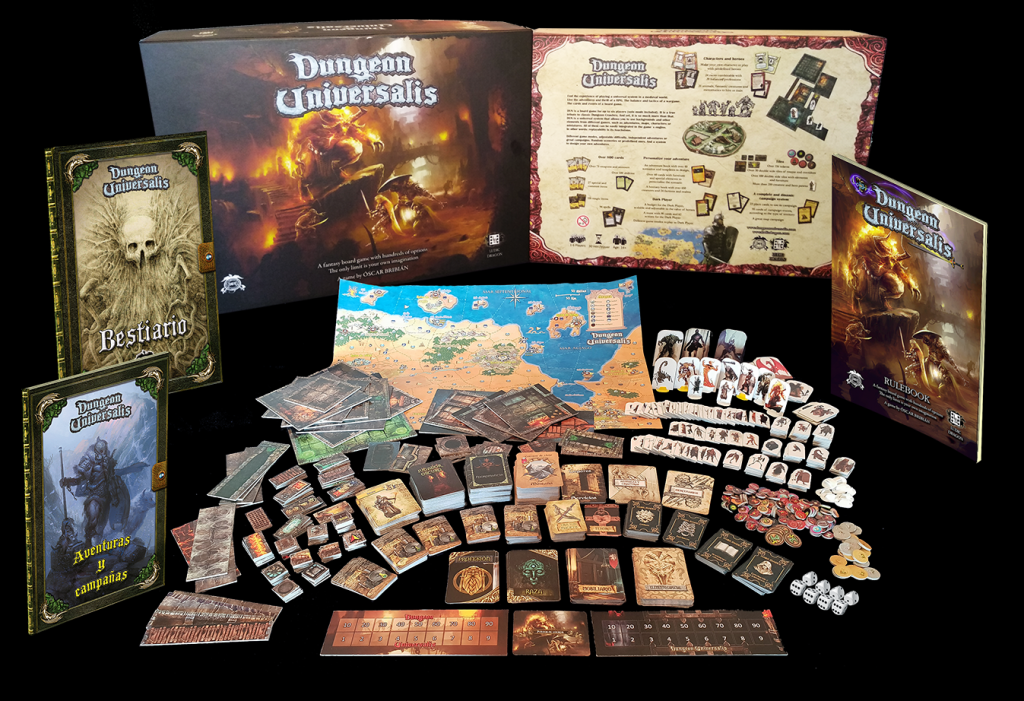
#1: Dungeon Universalis (2019)
Considered the big one among the RPG board game community, Dungeon Universalis does everything that League of Dungeoneers does, but even more. It is hands down the heaviest weight game in this list, and that’s a big part of why it sits in my #1 spot. I’ll definitely be doing a deeper dive review of this game some time, but for now, here are a few reasons why it’s in my top spot.
Roleplaying Master Class
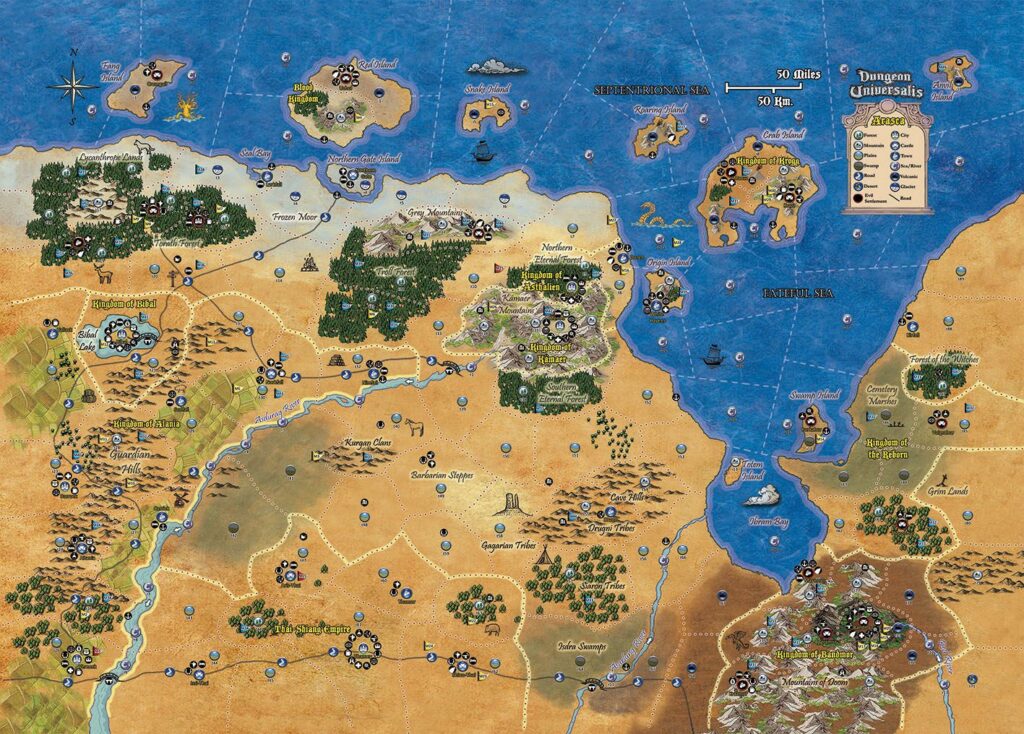
Taking other games and going ever farther, DUN has mechanics that go far beyond what other games do. Yes there’s character development, about on par with other RPGs and the aforementioned League of Dungeoneers, but goes even further. Arasca itself evolves over time. Enemies pour out of the big bad’s lair deep in a land that could be considered something like Mordor, and player driven events and decisions affect how the rest of the towns, and their citizens, react to the player.
One example are the events tied to visiting a city, or traveling on the road. While most games would have this be a thematic, yet simple event that typically doesn’t impact much, DUN amps that up. Some can be random combats, but they can also impact general services. In one of my first events in one of my first ever games of DUN I apparently insulted the king, so was banished from the capital city’s castle for a very long time.
Sandbox Adventure
Dungeon Universalis’ world of Arasca is wide open. Players are free to travel how they like and go anywhere they want. This isn’t the best idea, obviously, as foreign cultures may not like it and not even allow the party entry, or access to its services.
What this means is reputation is important, and players will need to consider it when travelling. DUN includes several campaigns in its core book alone, one large and two smaller ones, and each can be started and stopped at will. Side quests are in abundance too, with dozens for players to look for, earn, or stumble upon. Finally, the latest crowdfunding campaign included rules for a random dungeon mode. This is fantastic, as it means the game world is now truly an infinite sandbox of adventure, fully customizable to the player’s desire.
DMless RPG
Another similar point to League of Dungeoneers, DUN goes a step further by including rules for both an actual DM, called the Dark Player, and a DMless option using an ADP, or Artificial Dark Player.
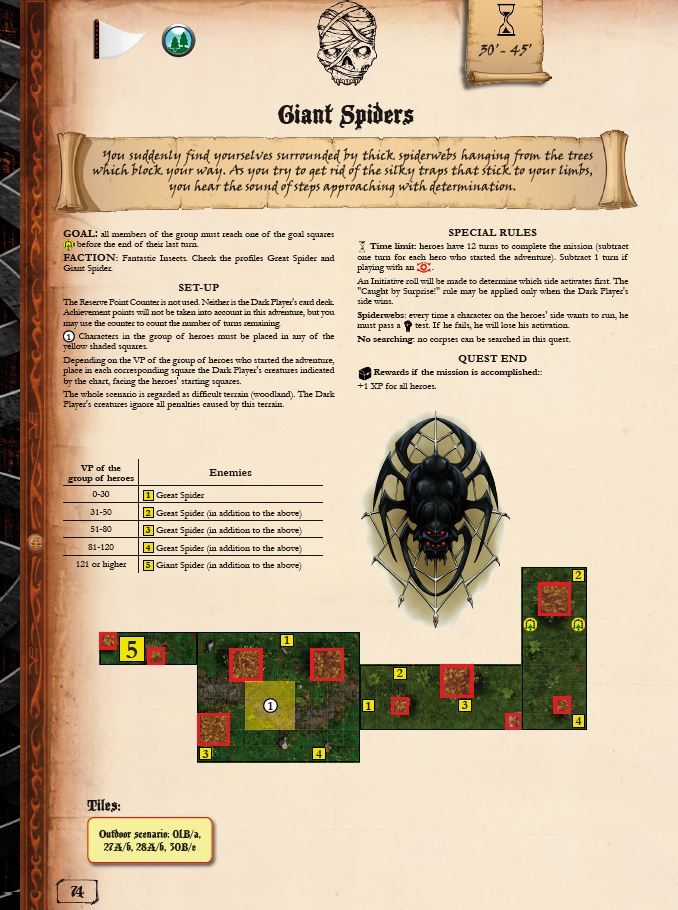
Building up cards that a Dark Player might use, the ADP spends dark points where possible to set off traps, boost monsters, and hinder the players. It’s not certain quite when something will happen, or even what, so players need to be on their toes at all time. I’ve had numerous instances where the very first door of the dungeon turned out to be a massive trap, with a near indestructible metal door and walls that close in to crush the party. I’ve also lucked out and ran almost entire dungeons with nary a problem in sight, running all the way to the lich’s tomb and taking him head on.
I’ll also mention that while DUN’s dungeons are not randomly generated and all pre-constructed, there is a free digital app the game uses to assist in exploration. While I personally don’t mind knowing the map layout ahead of time and just discovering the contents, I have used the app quite extensively and found it the perfect compliment for those that might want that feeling of the unknown. It’s not an app that needs you to keep your nose in it, just enough to keep the next tile hidden so you get the tension of exploration.
Mechanical Masterclass
There’s far too much to DUN to properly describe here. What I’ll say is that the rules are as large as any other RPG, including as much depth of possibility as the best of them might. Melee, blocking, damaging a weapon, shooting, friendly fire, magic, miscasting, counterspelling, many, many schools of magic with vast utility as well as damage, it’s all here.
Verdict
Truly a game for the ages, DUN reaches for the stars and hits something never seen before. I can absolutely see the game’s massive weight, unfocused design, and overbearing, often punishing gameplay being a turn off for many. Yet it’s a system as much as it is a game, and DUN can be easily modified, or just played more loosely as players want. For those sticking it out and keeping to the structure as best as possible are also going to find something great here. DUN is a game I’ll return to time and time again.
It’s unfortunate, but as of this writing, DUN is no longer being produced, or is planned to be in the future. Second hand copies exist, but they’re quite pricey. While I would consider the game worth an inflated price, as it truly is a forever game, interested players may also want to hold off for just a little bit. A second edition is planned for crowdfunding in 2027, and a sci-fi themed version is planned for later 2026. While this means delivery of these games are many years away, perhaps that’s fine. Games like this are timeless, just like the classic Warhammer Quest 1995, or it’s counterpart Heroquest. DUN will stand the test of time, so now or later doesn’t matter as long as you remain a fan of RPGs.